
Microplate Reader Optical Validation: SpectraTest Plates (IQ/OQ/PQ) & Bioprocess QC Software (AccuSEQ, ViralSeq) Compliance
A single fingerprint on a SpectraTest validation filter can cause a +0.045 OD optical drift, failing your microplate reader OQ during a cGMP audit. Here is our wet-lab SOP for SpectraTest ABS1/FL1 qualification, NIST recertification deadlines, and AccuSEQ baseline troubleshooting.
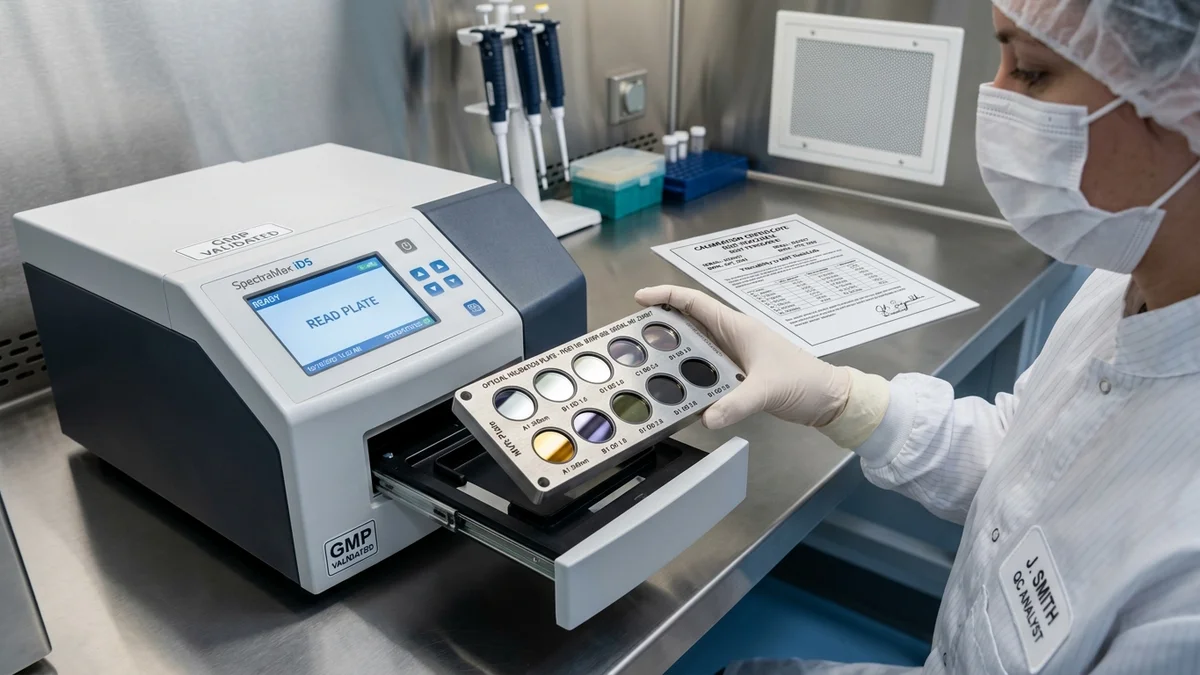
From Our Wet-Lab Bench: At 10:30 AM on Day 2 of an unannounced cGMP inspection in our analytical development suite, an FDA investigator sat down at the conference table, examined our commercial monoclonal antibody lot release binder, and requested the qualification history for Microplate Reader 03. When our QA coordinator pulled up the validation logbook, the room went dead silent: the NIST-traceable recalibration certificate for our SpectraTest ABS1 validation plate had expired fourteen days prior. The equipment coordinator assumed the plate had a two-year calibration interval instead of the strict 12-month factory recertification mandated by Molecular Devices. That single oversight triggered a formal 483 observation under 21 CFR § 211.160(b) and a two-week retrospective data review across twelve clinical drug substance batches. In this guide, we break down the exact optical physics, bench calibration pitfalls, and software data integrity workflows required to maintain microplate spectrophotometers and bioprocess qPCR software in continuous audit-ready compliance.
1. The Physics of Optical Drift: Why Microplate Readers Fail OQ #
In regulated biopharmaceutical quality control and clinical diagnostic laboratories, microplate readers (such as the Molecular Devices SpectraMax iD3/iD5, Paradigm, and M5e, or Tecan Spark/Infinite) perform critical release testing: host cell protein (HCP) ELISAs, endotoxin kinetic chromogenic assays, residual DNA quantitation, and cell-based potency bioassays.
Unlike simple single-cuvette spectrophotometers with fixed pathlengths, microplate readers operate in a complex optical geometry where light beams traverse vertical liquid columns across 96 or 384 individual wells. Over 6 to 12 months of continuous laboratory operation, reader performance drifts due to four physical aging processes:
  [1. XENON LAMP AGING]        [2. MONOCHROMATOR SHIFT]      [3. DUST & COATING DECAY]
   Flash intensity drops        Diffraction grating motor     Airborne particulates coat
   at UV wavelengths (<300nm)   leadscrew mechanical backlash  turning mirrors & splitters
            │                            │                               │
            └────────────────────────────┼───────────────────────────────┘
                                         ▼
                        [OPTICAL SYSTEM DRIFT & NOISE]
                         • Loss of Photometric Linearity (> 2.0 OD)
                         • Wavelength Inaccuracy (Peak shift > 1.5 nm)
                         • Well-to-Well Optical Crosstalk (> 0.15%)
- Xenon Flash Lamp Output Degradation: High-energy xenon arc flash lamps suffer spectral output decay—most severely in the ultraviolet band (230,nm to 320,nm). As lamp emission drops, the reader automatically increases photomultiplier tube (PMT) gain or integration time, elevating baseline electronic noise and reducing photometric dynamic range.
- Monochromator Mechanical Backlash: Dual scanning monochromators utilize motorized lead screws and holographic diffraction gratings to select discrete wavelengths. Mechanical thermal expansion and gear wear shift grating angles, creating a wavelength calibration offset of 1.5,nm to 3.0,nm. While negligible for broad absorption bands, this shift destroys assay precision in steep spectral regions (such as the 405,nm kinetic chromogenic LAL endotoxin slope).
- Internal Mirror & Lens Particulate Deposition: Cooling fans draw ambient laboratory air through the chassis. Over time, aerosolized buffer salts, moisture, and micro-dust coat the beam splitters and turning mirrors, increasing stray light leakage and distorting optical density readings above 2.0,OD.
2. The SpectraTest Validation Plate Architecture: ABS1, FL1, and LM1 #
To eliminate the hazardous preparation, storage instability, and environmental variation of wet chemical standards (such as carcinogenic potassium dichromate solutions or acidic liquid dyes), Molecular Devices engineered the solid-state SpectraTest Validation Plate family.
Each SpectraTest plate features precision-machined aluminum frames housing solid-state optical standards certified by Molecular Devices against National Institute of Standards and Technology (NIST) and National Physical Laboratory (NPL) primary standards.
  ┌────────────────────────────────────────────────────────────────────────┐
  │  SPECTRATEST ABS1 ABSORBANCE VALIDATION CASSETTE                       │
  │  ┌──────┐ ┌──────┐ ┌──────┐ ┌──────┐ ┌──────┐ ┌──────┐ ┌──────┐ ┌──────┐│
  │  │FILTER│ │FILTER│ │FILTER│ │FILTER│ │FILTER│ │FILTER│ │FILTER│ │FILTER││
  │  │  #1  │ │  #2  │ │  #3  │ │  #4  │ │  #5  │ │  #6  │ │  #7  │ │  #8  ││
  │  │Holmium│ │Holmium│ │Neutral│ │Neutral│ │Neutral│ │Neutral│ │Stray │ │Air   ││
  │  │UV/Vis │ │Visible│ │0.2 OD │ │0.6 OD │ │1.0 OD │ │2.0 OD │ │Light │ │Blank ││
  │  └──────┘ └──────┘ └──────┘ └──────┘ └──────┘ └──────┘ └──────┘ └──────┘│
  └────────────────────────────────────────────────────────────────────────┘
A. SpectraTest ABS1 (Absorbance Qualification) #
- Holmium Oxide Glass Filters: Provides certified, ultra-sharp absorption peaks at discrete wavelengths (279,nm, 361,nm, 453,nm, 536,nm, and 636,nm). SoftMax Pro reads through these filters to verify wavelength accuracy within ± 1.0,nm and wavelength repeatability within ± 0.2,nm.
- Calibrated Neutral Density (ND) Filters: Precision synthetic silica glass filters with deposited metallic absorbing layers producing nominal absorbance values of approximately 0.2, 0.6, 1.0, 1.6, 2.0, and 2.8,OD. These test photometric accuracy and linearity across the linear working range of microplate assays.
- Stray Light Blocking Filter: An optical glass filter that completely absorbs all light below 380,nm. If any detector signal is measured at 220,nm, it represents stray light leakage within the monochromator chamber (must remain below 0.05% transmission).
B. SpectraTest FL1 (Fluorescence Qualification) #
- Solid-State Fluorescent Fluorophore Blocks: Contains stabilized, sealed fluorophores emitting across four common excitation/emission channels:
- Blue/UV Channel: Ex 360,nm / Em 460,nm (DAPI, Hoechst, 4-MUG).
- Green Channel: Ex 485,nm / Em 538,nm (Fluorescein, FITC, GFP, Quant-iT Picogreen).
- Red Channel: Ex 544,nm / Em 590,nm (Rhodamine, Cy3, Resorufin).
- Far-Red Channel: Ex 640,nm / Em 670,nm (Cy5, Alexa Fluor 647).
- Key Tests: Evaluates fluorescence sensitivity, signal-to-noise ratio, PMT dynamic linearity, well-to-well crosstalk (ensuring bright fluorescent signals do not bleed into adjacent dark wells), and RFU repeatability.
C. SpectraTest LM1 (Luminescence Qualification) #
- Designed for luminometers and multi-mode instruments measuring luciferase reporter genes, ATP cell viability assays (CellTiter-Glo), and flash/glow chemiluminescence.
- Features internal light-emitting phosphorescent reference sources and optical attenuators testing background dark current, detector linear response, and carriage positional repeatability.
3. The Fingerprint & Lint Trap: Bench Cleaning and Recalibration SOP #
In our audits of QC laboratories, more than 70% of SpectraTest OQ failures are false-positive failures caused by improper storage, dust contamination, or skin oil on the optical quartz windows.
A single microscopic fingerprint deposit transfers approximately 0.5,mug/cm2 of sebaceous lipids and skin squalene onto the quartz glass surface. At 405,nm and 450,nm, this lipid haze scatters incident photons, producing an artificial optical density spike of +0.035 to +0.060,OD.
When SoftMax Pro runs its automated calibration curve comparison, this deviation throws the calculated slope outside the factory certified tolerance (pm 0.006,OD ± 1.0%), causing the software to flag the reader as "FAIL: PHOTOMETRIC ACCURACY".
Critical Cleaning Protocol: #
- Never use canned compressed air ("dusters"). Propellants (difluoroethane) leave a thin fluorinated oil film on cold optical glass that permanently alters UV absorbance. Use only dry, oil-free lab nitrogen gas or a manual rubber bulb blower.
- Optical Solvent Cleaning: If particulate dust cannot be dislodged with nitrogen, moisten (do not soak) an optical-grade lens cleaning tissue (Whatman Lens Tissue Grade 105) with spectrophotometric-grade anhydrous isopropanol (IPA ≥ 99.9%).
- The "Single-Direction Sweep" Technique: Gently drag the moistened lens paper in a single continuous linear motion across the filter aperture without applying downward fingertip pressure. Never scrub in circles, as silica particulates will scratch the metallic neutral-density coating.
- The 1-Year Recertification Hard Deadline: Every SpectraTest plate contains internal calibration coefficients encoded in the certificate of analysis. Because glass solarization and metallic oxidation alter optical density over time, Molecular Devices certifies calibration for exactly 12 months (or 24 months for newer select models). Using an expired validation plate automatically invalidates any subsequent instrument OQ in a cGMP regulatory audit.
4. Comprehensive Validation Matrix: SpectraTest vs. Chemical Standards #
The following comparison matrix details the analytical capabilities, regulatory acceptance, and operational trade-offs of microplate validation methodologies:
| Parameter | SpectraTest ABS1 (Solid-State) | SpectraTest FL1 (Fluorescence) | Liquid Potassium Dichromate (NIST SRM 935a) | Liquid p-Nitrophenol / Methyl Red Solutions |
|---|---|---|---|---|
| Primary Qualification Use | Absorbance Spectrophotometers | Multi-Mode Fluorescence Readers | Absorbance Calibration (Cuvettes & Microplates) | Pathlength Correction & Photometric Linearity |
| Wavelength Range | 250,nm - 850,nm | 360,nm - 670,nm (4 channel pairs) | 235,nm - 350,nm (UV only) | 405,nm, 450,nm, 490,nm |
| Photometric Accuracy Tolerance | ± 0.006,OD ± 1.0% | Linearity R2 ≥ 0.995 | ± 0.005,OD | ± 0.010,OD (Depends on pipetting CV) |
| Wavelength Accuracy | ± 1.0,nm (Holmium peaks) | ± 1.5,nm spectral response | ± 0.5,nm (Sharp UV minima/maxima) | Not applicable (Broad spectra) |
| Preparation Labor | Zero (Insert plate and run SOP) | Zero (Insert plate and run SOP) | High (Serial dilution in 0.001,M HClO4) | Moderate (Gravimetric buffer prep) |
| Hazardous Waste | None (Solid-state non-hazardous) | None (Solid-state non-hazardous) | Toxic & Carcinogenic (Hexavalent Chromium) | Non-hazardous biological buffer |
| Recalibration Frequency | Factory recertified every 12 months | Factory recertified every 12 months | Prepare fresh or replace every 6 months | Single-use only |
| Audit Acceptance (US FDA / EMA) | Universally Accepted (Automated GxP) | Universally Accepted (Automated GxP) | Pharmacopeial Gold Standard (EP/USP) | Internal PQ only (Not primary OQ) |
5. Bioprocess QC Software Mastery: AccuSEQ, ViralSeq & LinkSeq Realities #
While the microplate reader measures optical signals, the analytical conclusions—whether a multi-million-dollar biotherapeutic batch meets release specifications—depend on the integrity of specialized bioprocess quality control software.
In downstream biomanufacturing and GMP release testing, three software suites dominate: Applied Biosystems AccuSEQ, ViralSeq, and LinkSeq.
  [BIOTHERAPEUTIC CELL HARVEST] ──► [DOWNSTREAM PURIFICATION] ──► [FINAL DRUG SUBSTANCE]
                                              │                               │
                                              ▼                               ▼
                                  [AccuSEQ REAL-TIME PCR]         [ViralSeq CLEARANCE]
                                  • CHO / E. coli resDNA           • Adventitious Virus Screening
                                  • LOQ: ≤ 1.5 pg/reaction        • Residual Retrovirus Testing
                                  • Standard Curve R² ≥ 0.990      • Log10 Reduction Value (LRV)
A. AccuSEQ Real-Time PCR Software: Host Cell Residual DNA (resDNA) Quantitation #
Regulatory agencies (FDA, EMA, WHO) mandate that final injectable biotherapeutics contain less than 10 ng of residual host cell DNA (resDNA) per therapeutic dose, with DNA fragment sizes ideally below 200,bp.
AccuSEQ software automates quantitative PCR (qPCR) data analysis using TaqMan chemistry targeted to specific host cell genomes (such as Chinese Hamster Ovary [CHO], E. coli, Vero, or HEK293):
- The Baseline Clipping Disaster: AccuSEQ calculates threshold cycles (Ct) based on automated baseline start and stop cycles. In high-concentration residual DNA samples containing trace organic extraction solvents (such as residual ethanol or guanidine isothiocyanate from automated prep stations), early background fluorescence curves exhibit non-linear baseline drift.
- The Bench Pitfall: If AccuSEQ automatically clips the baseline between Cycle 3 and Cycle 10, the subtraction algorithm creates a false early take-off curve, skewing the calculated Ct value from Cycle 34 down to Cycle 29. A sample containing only 2.1,pg/mL of benign CHO DNA will suddenly calculate at 68,pg/mL—triggering an artificial Out-of-Specification (OOS) batch rejection.
- The SOP Rule: Analysts must manually verify the raw multicomponent amplification plots. Ensure the baseline start is set 2 cycles after the initial fluidic stabilization (> Cycle 5) and ends at least 2 cycles prior to the earliest exponential amplification take-off.
- Standard Curve Validation Acceptance Criteria:
For an AccuSEQ resDNA assay run to be legally valid for batch release:
- Standard curve correlation coefficient must achieve R2 ≥ 0.990.
- The slope must fall between -3.10 and -3.58 (corresponding to amplification efficiencies between 90% and 110%).
- No-Template Controls (NTC) must show either no amplification or a Ct value at least 10 cycles higher than the lower limit of quantitation (LLOQ).
B. ViralSeq Software: Adventitious Agent Clearance & Retroviral Screening #
Biomanufacturing cell lines (particularly rodent CHO cells) naturally express endogenous retrovirus-like particles (RVLPs). Bioprocess downstream clearance chromatography must achieve validated log10 reduction values (LRV) > 12 to 16.
ViralSeq software powers automated viral clearance validation testing (such as Minute Virus of Mice [MVM] or Vesivirus) via TaqMan real-time PCR:
- Resolving False Priming in Viral Clearance Spiking Studies: During viral clearance challenge studies, downstream chromatography elution pools contain high concentrations of denaturing chaotropic salts or low-pH elution buffers (0.1,M sodium citrate, pH 3.0). In ViralSeq runs, these matrix interferences alter TaqMan probe annealing kinetics, generating plateau-depressed amplification curves.
- The Wet-Lab Fix: Analysts must incorporate Internal Positive Control (IPC) synthetic RNA/DNA templates into every sample well. If the IPC Ct shifts by more than ± 1.0,cycle relative to the control matrix, the viral reduction value cannot be legally accepted—the sample must undergo matrix neutralization or automated silica-column cleanups before re-running.
C. LinkSeq Software: Rapid Real-Time PCR HLA Typing #
In clinical bone marrow transplants and donor matching, LinkSeq software automates Human Leukocyte Antigen (HLA) gene typing utilizing sequence-specific primers and real-time fluorescent melt-curve/endpoint detection.
- Crosstalk & Multi-Dye Deconvolution: LinkSeq detects multiple alleles per well by deconvolving overlapping fluorescent reporter dyes (FAM, VIC, ROX, Cy5).
- The Bench Pitfall: Microplate reader lamp aging or thermal non-uniformity across the 384-well block introduces temperature variations of ± 0.4°C. In high-resolution melting curve analysis, a 0.4°C drift shifts the calculated melting temperature (Tm), causing the LinkSeq algorithm to assign an incorrect HLA allele subtype.
- The SOP Rule: Monthly optical calibration using certified multi-color calibration plates must be performed, coupled with on-block thermistor temperature verification.
6. Data Integrity & 21 CFR Part 11 Audit Trail Review Architecture #
In modern pharmaceutical inspections, FDA and MHRA auditors no longer look primarily at the printed analytical test report—they look at the underlying relational database audit trail.
Both Molecular Devices SoftMax Pro GxP and Applied Biosystems AccuSEQ feature mandatory 21 CFR Part 11 technical compliance architectures that laboratories must actively manage:
  ┌────────────────────────────────────────────────────────────────────────┐
  │ 21 CFR PART 11 COMPLIANT AUDIT TRAIL ARCHITECTURE                      │
  ├────────────────────────────────────────────────────────────────────────┤
  │ [SYSTEM EVENT LOG]                                                     │
  │ • User Login / Logout / Failed Password Lockouts (Timestamped UTC)     │
  │ • Optical Calibration Pass / Fail Records                              │
  │                                                                        │
  │ [PROJECT / BATCH EVENT LOG]                                            │
  │ • Baseline Start / Stop Parameter Changes (Requires User Reason Code)   │
  │ • Standard Curve Outlier Masking (Requires Supervisor Dual-Signature)  │
  │ • Data Re-analysis & Electronic Signature Execution                    │
  └────────────────────────────────────────────────────────────────────────┘
The Five "Red Flags" Auditors Search For: #
- The "Trial Injection" or Test Run: Running an assay plate on a microplate reader under an unlogged "Demo" or "Test" project file to see if results pass, before running it officially under the GxP folder. In SoftMax Pro GxP, all raw optical read events are recorded in the secure SQL database ledger; unlinked plate reads are immediately flagged during forensic audit trail reconstruction.
- Shared Operator Accounts: Never permit shared logins (such as "QC_Analyst" or "Lab_Tech"). Every single microplate read, baseline edit, and standard curve approval must correlate to a unique corporate Active Directory username with cryptographic digital signatures.
- Unjustified Data Point Masking: If a calibrator well in an AccuSEQ standard curve deviates, an analyst cannot simply right-click and "Omit Well" without generating an automated audit trail prompt requiring a written, scientifically valid justification (e.g., "Well C2 omitted due to documented automated tip-dispense bubble artifact documented in Lab Notebook Entry #412").
- Time-Stamp Discrepancies: Ensure all acquisition workstations synchronize their system clocks to a centralized Network Time Protocol (NTP) server. A 5-minute discrepancy between the microplate reader PC and the corporate LIMS server will trigger immediate data integrity citations.
- Separation of Duties: The individual with System Administrator privileges (the ability to configure user roles, archive databases, or modify system time) must never be an active laboratory analyst who runs release tests. In smaller facilities, designate an independent IT professional or Corporate QA Lead as the System Admin.
By integrating rigorous physical maintenance of SpectraTest validation cassettes with disciplined software parameter control in AccuSEQ and SoftMax Pro GxP, biopharmaceutical testing facilities ensure their analytical data remains unimpeachable through every regulatory audit.
Expert Technical & Engineering FAQs
1How often must a SpectraTest ABS1 validation plate be sent back to Molecular Devices for factory recertification?▾
2Can an analyst clean a dirty SpectraTest validation plate with laboratory ethanol or acetone?▾
3What causes a false-positive high residual DNA result in AccuSEQ qPCR software?▾
4What is the difference between microplate reader IQ, OQ, and PQ?▾
5Why do regulatory auditors scrutinize audit trails in SoftMax Pro GxP and AccuSEQ software?▾
BioScienceDesk Editorial & Research Desk
Verified Institutional PublicationA Jayanti Cybernetics Life Sciences Media Division
Our technical guides, comparative benchmarks, and protocol troubleshooting analyses are synthesized by our editorial research desk under the governance of our Scientific Advisory Board.
Are you an R&D Scientist, Application Specialist, or Lab Director?
Feature your technical article, research insight, or equipment review with full author byline & LinkedIn credit.
Related Insights in Laboratory Science & Gear
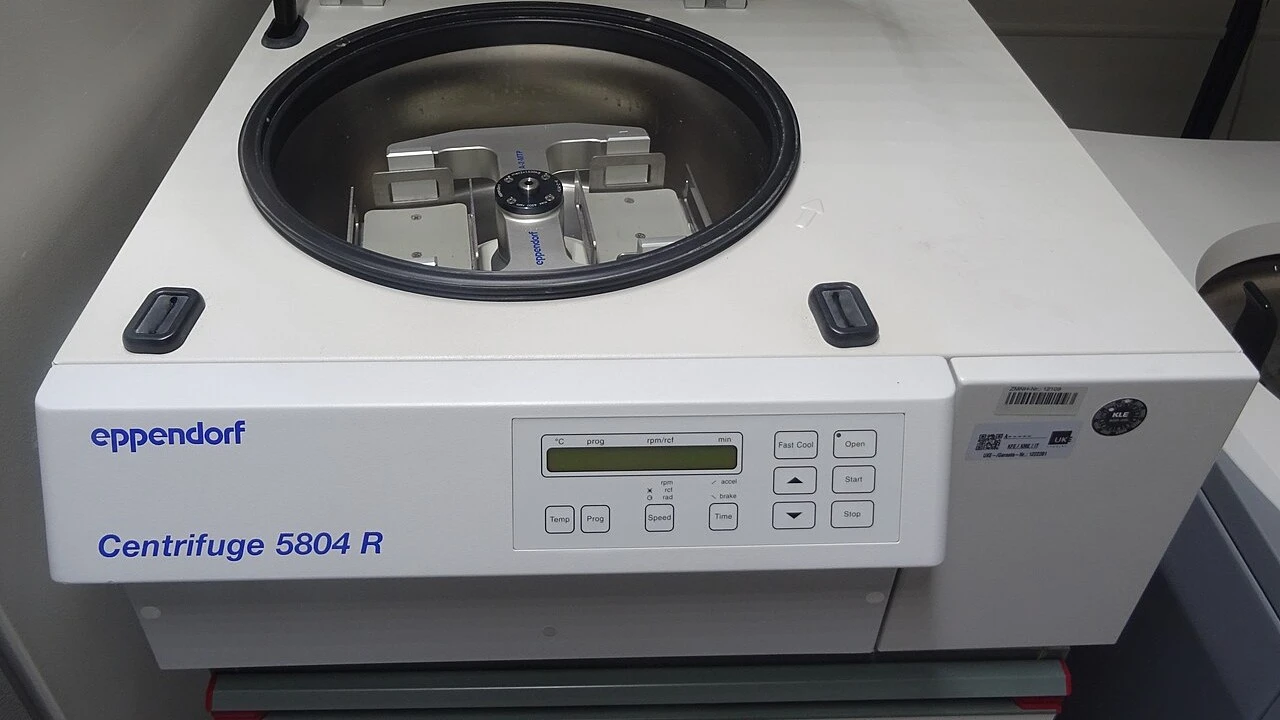
Best Benchtop Clinical Centrifuges for High-Throughput Blood and Plasma Separation (2026 Review)
Brochure RPM figures mean very little during a 400-tube morning phlebotomy rush. We evaluate clinical swing-bucket centrifuges on what actually matters: rotor chamber heating across back-to-back cycles, thixotropic SST gel-barrier integrity at 3,000 x g, aerosol-tight biocontainment buckets, and brushless soft-brake deceleration profiles that prevent buffy-coat resuspension in liquid biopsy and Troponin STAT workflows.
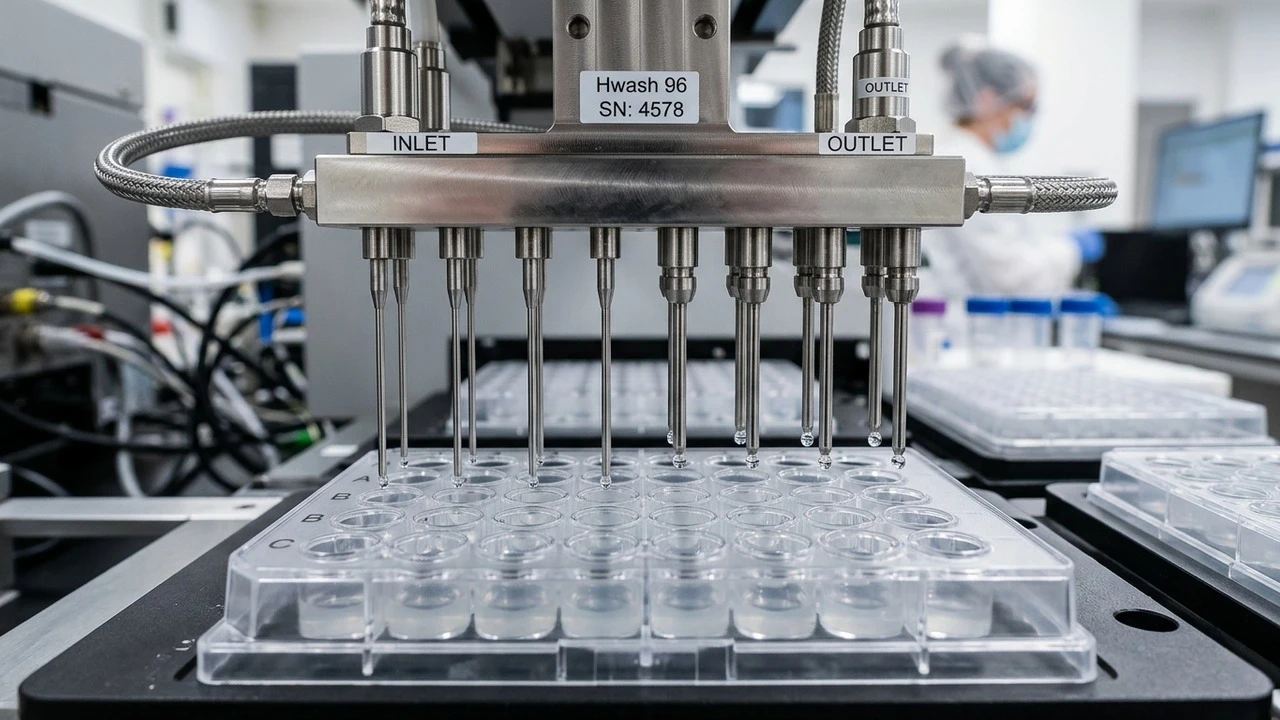
Preventing Manifold Pin Clogging in Automated 96-Well Microplate Washers
One partially crystallized PBS salt bridge inside a single aspiration needle is enough to ruin CV% across an entire 96-well ELISA plate. Follow this daily deionized rinse and ultrasonic pin maintenance routine to keep residual well volumes under 2 uL.
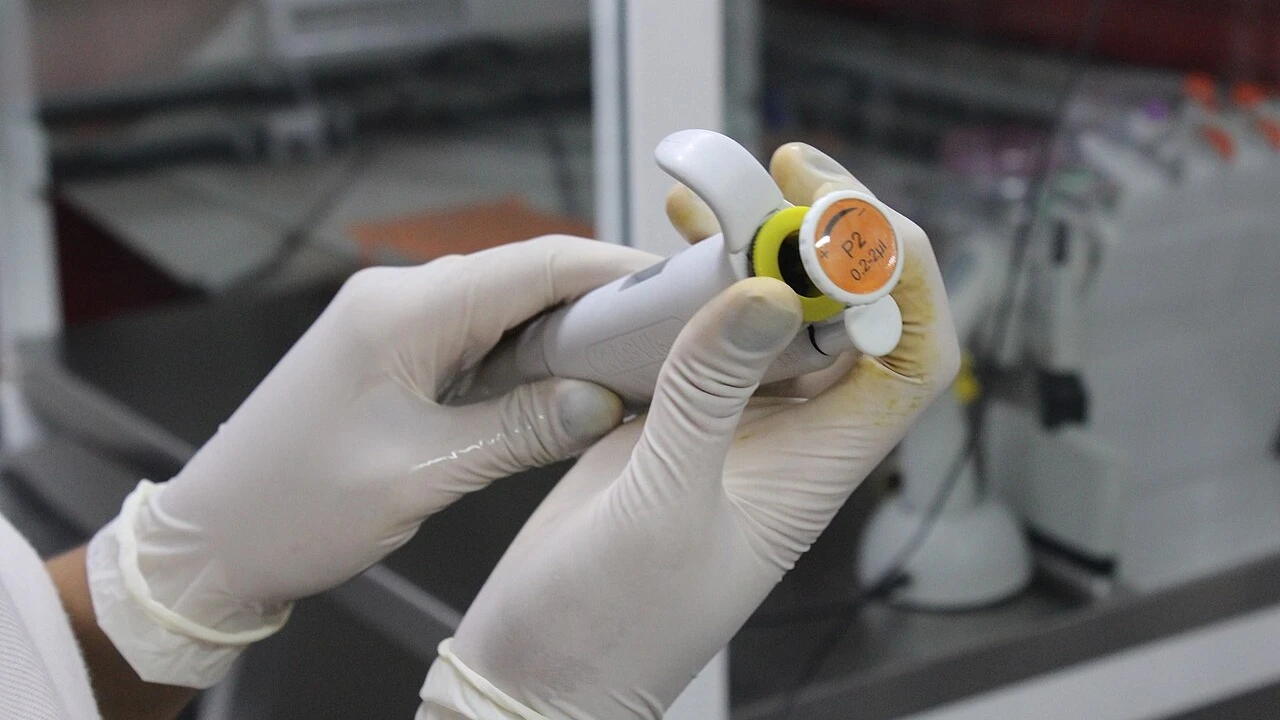
ISO 8655 Gravimetric Pipette Calibration: Routine Quality Control Checklist for Labs
Thumb-spring fatigue and warmed hand-held barrels quietly push 10 uL air-displacement pipettes up to 4% out of tolerance between annual vendor visits. Here is the exact 10-weighing gravimetric ISO 8655 verification protocol any QC lab can run in-house.
Get Latest Life Science Insights & Guides in Your Inbox
Bi-weekly diagnostic articles, laboratory troubleshooting guides, and equipment reviews.