For more than twenty years, surgical oncologists and medical oncologists have adhered to an unyielding clinical algorithm in resectable stage III colon cancer: perform an oncologic surgical resection with high vascular ligation, harvest at least 12 regional lymph nodes, and promptly initiate six months of fluoropyrimidine and oxaliplatin-based adjuvant chemotherapy (mFOLFOX6 or CAPOX).
Ever since the landmark MOSAIC trial established oxaliplatin's superiority in 2004, that postoperative sequence has been the foundational benchmark. Yet for patients harboring mismatch repair-deficient (dMMR) or microsatellite instability-high (MSI-H) tumors—representing approximately 12% to 15% of stage II/III colon cancers—standard adjuvant fluoropyrimidines have long presented a biological paradox: relative intrinsic chemoresistance coupled with the debilitating cumulative burden of oxaliplatin-induced sensory peripheral neuropathy.
On October 8, 2026, the regulatory paradigm fundamentally shifted. The U.S. Food and Drug Administration granted landmark approval to atezolizumab (Tecentriq) and its subcutaneous formulation atezolizumab and hyaluronidase-tqjs (Tecentriq Hybreza) in combination with a fluoropyrimidine and oxaliplatin for the adjuvant treatment of stage III dMMR colon cancer following surgical resection.
Supported by the Alliance A021502 (ATOMIC) Phase 3 trial, which demonstrated an extraordinary 50% reduction in the hazard of disease recurrence or death, the approval marks the first time an immune checkpoint inhibitor has entered the curative adjuvant setting for colon cancer.
Yet even as the biopharma industry celebrates this regulatory milestone, an explosive biological question is echoing across surgical suites and multidisciplinary tumor boards:
Are we delivering immunotherapy at the wrong end of the surgical timeline?
While ATOMIC establishes the new adjuvant standard-of-care, long-term follow-up from the Phase 2 NEOPRISM-CRC trial reported that a brief, 9-week course of preoperative (neoadjuvant) pembrolizumab achieved a 59% pathological complete response rate—and at roughly 33 months of median follow-up, generated a 0% cancer recurrence rate across treated patients.
The resulting clinical tension between adjuvant chemo-immunotherapy escalation and neoadjuvant chemo-omission de-escalation represents the defining debate in gastrointestinal oncology for the decade ahead.
The Regulatory Anchor: Decoding the Phase 3 ATOMIC Trial #
The FDA's October 8, 2026 approval of atezolizumab in stage III dMMR colon cancer is anchored in the Alliance A021502 (ATOMIC) trial (NCT02912559), a randomized, open-label, international Phase 3 study evaluating 712 patients with surgically resected stage III dMMR colon adenocarcinoma.
Patients were randomized 1:1 to receive either:
- Control Arm: Standard mFOLFOX6 (oxaliplatin 85 mg/m², leucovorin 400 mg/m², 5-FU bolus 400 mg/m², and infusional 5-FU 2400 mg/m² over 46 hours) every 2 weeks for 12 cycles (6 months).
- Experimental Arm: Standard mFOLFOX6 plus atezolizumab (840 mg IV every 2 weeks) for 12 cycles (6 months), followed by maintenance atezolizumab (1200 mg IV every 3 weeks or 840 mg every 2 weeks) monotherapy for an additional 6 months (total treatment duration: approximately 12 months).
+---------------------------------------------------------------------------------------------------+
|                           PHASE 3 ATOMIC (ALLIANCE A021502) PIVOTAL METRICS                       |
+------------------------------------+--------------------------+-----------------------------------+
| Clinical Endpoint                  | mFOLFOX6 Alone (n=356)   | Atezolizumab + mFOLFOX6 (n=356)   |
+------------------------------------+--------------------------+-----------------------------------+
| Median Follow-Up                   | 40.9 months              | 40.9 months                       |
| 3-Year Disease-Free Survival (DFS) | 76.2% (95% CI: 71.3-80.4)| 86.3% (95% CI: 82.2-89.6)         |
| Absolute DFS Benefit               | Baseline reference       | +10.1% absolute improvement       |
| Hazard Ratio (DFS)                 | 1.00 (Reference)         | 0.50 (95% CI: 0.35 - 0.73)        |
| Statistical Significance           | --                       | Stratified log-rank p < 0.001     |
| Total Regimen Duration             | 6 months                 | 12 months (6m Chemo-IO + 6m IO)   |
+------------------------------------+--------------------------+-----------------------------------+
The results were statistically decisive. At a median follow-up of 40.9 months, adding atezolizumab to adjuvant mFOLFOX6 reduced the risk of disease recurrence or death by exactly 50% (Hazard Ratio: 0.50; 95% CI: 0.35 to 0.73; p < 0.001). The 3-year disease-free survival jumped from 76.2% in the chemotherapy arm to 86.3% in the chemo-immunotherapy arm—an absolute delta of 10.1 percentage points.
Importantly, the FDA approved both the intravenous formulation (Tecentriq) and the co-formulated subcutaneous injection with recombinant human hyaluronidase (Tecentriq Hybreza), allowing rapid 7-minute subcutaneous administration that significantly reduces infusion-chair time for biopharma oncology infusion centers.
Clinically, the ATOMIC data conclusively proves that dMMR stage III colon tumors—despite their historical unresponsiveness to 5-FU monotherapy—are exquisitely sensitive to immune checkpoint inhibition when micrometastatic disease is challenged in the adjuvant setting.
The Preoperative Counter-Offensive: Phase 2 NEOPRISM-CRC and Zero Recurrences #
While ATOMIC cemented adjuvant chemo-IO, investigators at University College London (UCL) Cancer Institute and Cancer Research UK took an diametrically opposed tactical approach: challenging the disease before the surgeon ever picks up a scalpel.
The Phase 2 NEOPRISM-CRC trial (NCT05197322) evaluated whether a short preoperative course of pembrolizumab could eliminate tumor burden prior to planned surgical resection in 32 patients with untreated, high-risk stage II (T4b N0) or stage III (any T, N1-2) dMMR/MSI-high colorectal adenocarcinoma.
Under the protocol:
- Patients received neoadjuvant pembrolizumab (200 mg IV every 3 weeks) for up to 3 cycles (a total treatment window of just 9 weeks) prior to elective surgical resection.
- Patients were prospectively stratified by tumor mutational burden (TMB): TMB-high and TMB-intermediate patients received 3 cycles (9 weeks), while TMB-low patients received 1 cycle (3 weeks).
- Postoperative chemotherapy was entirely optional, administered solely at the treating multidisciplinary team's discretion based on pathologic staging.
The surgical and pathological results were astonishing:
- Pathological Complete Response (pCR): 59% of evaluable resected tumors (19 out of 32 tumors) exhibited a complete pathological response (TRG 0), meaning not a single viable malignant cell remained in either the primary bowel wall or harvested regional lymph nodes.
- Intention-to-Treat (ITT) Patient pCR: 53% of all enrolled patients (17 out of 32 patients) achieved a verified pCR (the discrepancy reflecting one patient presenting with synchronous primary colorectal tumors).
- Major Pathological Response: Over 75% of patients achieved near-total tumor regression (<10% residual viable tumor cells).
- Long-Term Durability at 33 Months: At a median follow-up of 32.9 months (approaching 3 full years), zero patients (0 out of 32) had experienced disease recurrence. Even patients who had small micro-foci of residual disease at resection remained completely disease-free without disease progression.
+---------------------------------------------------------------------------------------------------+
|                        CROSS-STRATEGY COMPARATIVE FRAMEWORK: ATOMIC VS. NEOPRISM-CRC              |
+------------------------------------+--------------------------+-----------------------------------+
| Dimension                          | Adjuvant Strategy: ATOMIC| Neoadjuvant Strategy: NEOPRISM    |
+------------------------------------+--------------------------+-----------------------------------+
| Primary Agent                      | Atezolizumab (Anti-PD-L1)| Pembrolizumab (Anti-PD-1)         |
| Partner Therapy                    | mFOLFOX6 (Chemotherapy)  | None (Immunotherapy Monotherapy)  |
| Timing Relative to Surgery         | Postoperative (Adjuvant) | Preoperative (Neoadjuvant)        |
| Duration of Immunotherapy          | 12 months (~1 year)      | 9 weeks (~2.1 months)             |
| Oxaliplatin Exposure               | 6 months mandatory       | 0 months required (Discretionary) |
| Primary Endpoint                   | Disease-Free Survival    | Pathological Complete Response    |
| Clinical Outcome                   | 3-Year DFS: 86.3%        | 33-Month Recurrence: 0.0%         |
| Level of Evidence                  | Phase 3 Randomized (n=712)| Phase 2 Single-Arm (n=32)         |
| Regulatory Status                  | FDA Approved (Oct 8, 2026)| Investigational Trial Readout     |
+------------------------------------+--------------------------+-----------------------------------+
The Immunological Battlefield: Why Neoadjuvant Priming Mechanistically Outperforms Adjuvant Clearance #
To understand why a 9-week preoperative immunotherapy regimen could yield zero recurrences while a 12-month adjuvant chemo-IO regimen reports an 86.3% DFS, one must examine the fundamental biophysics of anti-tumor immunity in lymphoid architecture.
ADJUVANT IMMUNOTHERAPY (Post-Surgery):
[Primary Tumor & Sentinel Nodes Resected]
       │
       ▼
Sparse Circulating Micrometastases (Low Antigen Density)
       │
       ▼
Anti-PD-L1 Administration ──> Modest Clonal Expansion of Memory T-Cells
       │
       ▼
3-Year DFS: 86.3% (Residual 13.7% Recurrence Risk)

VS.

NEOADJUVANT IMMUNOTHERAPY (Pre-Surgery):
[Intact Primary Tumor Mass + Intact Draining Lymph Nodes]
       │
       ▼
Continuous Neoantigen Shedding into Sentinel Lymph Node Basins
       │
       ▼
Anti-PD-1 Administration ──> Massive Polyclonal CD8+ T-Cell Repertoire Expansion
       │
       ▼
Systemic Immune Clearance of Micrometastases BEFORE Surgical Knife
       │
       ▼
33-Month Cohort Recurrence: 0.0%
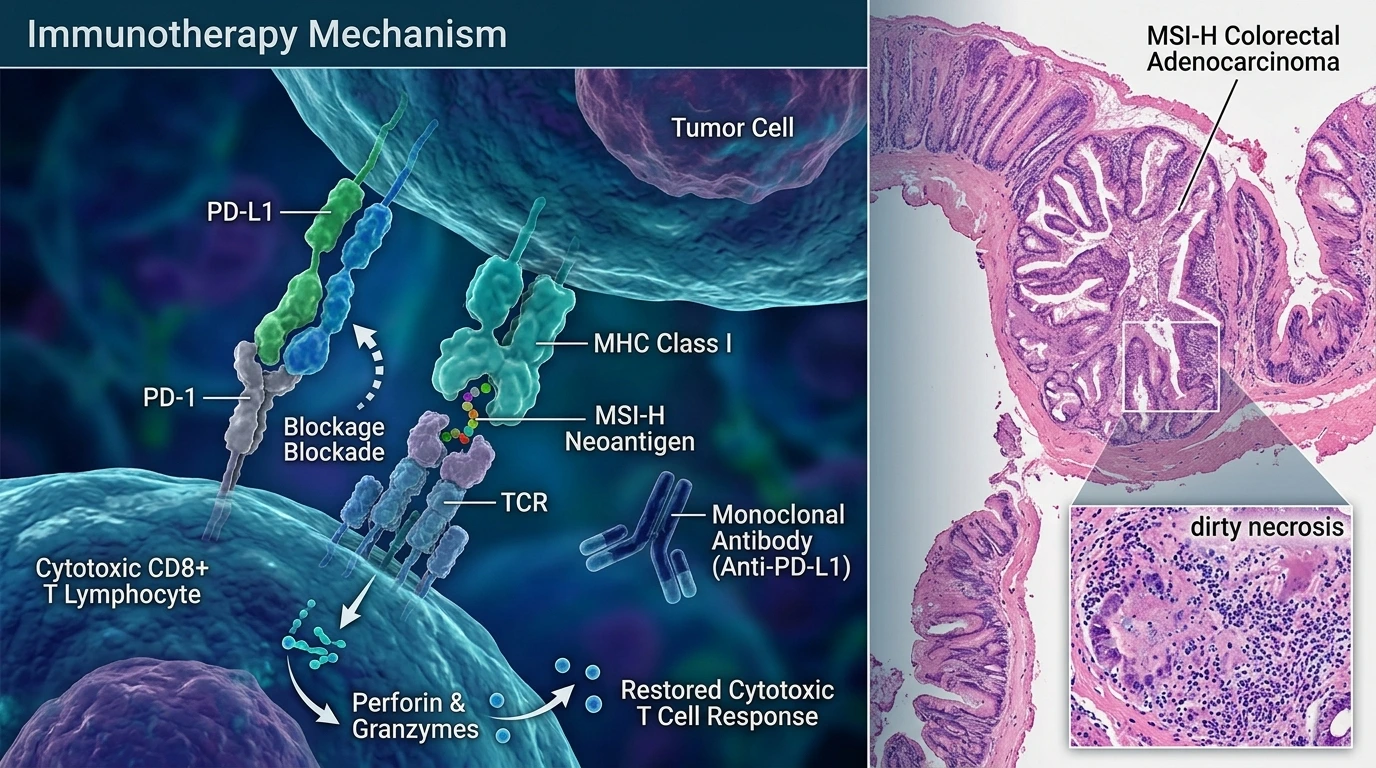
In dMMR/MSI-high colorectal cancer, defective DNA mismatch repair proteins (MLH1, MSH2, MSH6, PMS2) lead to hypermutation, accumulating thousands of insertion/deletion frameshift mutations per megabase. This generates a dense library of immunogenic neopeptides.
When checkpoint inhibitors are administered neoadjuvantly:
- The Primary Tumor as a Living Antigen Reservoir: The macroscopic primary tumor continuously sheds hundreds of distinct neoantigens directly into intact afferent lymphatics, where CD103+ Batf3-lineage classical dendritic cells capture, process, and cross-present them to naive and memory CD8+ T lymphocytes.
- Polyclonal T-Cell Repertoire Diversification: Exposure to checkpoint blockade while tumor architecture is fully vascularized triggers robust expansion of high-affinity tumor-infiltrating lymphocytes (TILs). T-cell receptor (TCR) sequencing demonstrates that neoadjuvant treatment generates a far wider diversity of circulating tumor-specific clonotypes compared to post-resection therapies.
- Preemptive Micrometastatic Elimination: These newly primed, circulating effector T cells distribute systemically through the bloodstream prior to surgical trauma, hunting and destroying dormant micrometastases in the liver, peritoneum, and distant lymph nodes before immunosuppressive postoperative wound-healing cytokines (such as TGF-beta and VEGF) can foster a metastatic niche.
In adjuvant administration, by contrast, the surgeon removes both the primary tumor and the sentinel draining lymph nodes. The patient is left with microscopic, low-volume disease pockets. In the absence of a high-density, centralized neoantigen factory, anti-PD-L1 antibodies must rely on peripheral memory T cells encountering scarce, scattered antigens. While ATOMIC proves this adjuvant approach is highly effective (HR 0.50), the biological ceiling is constrained compared to intact preoperative priming.
The Neurotoxicity Trap: The Human and Economic Cost of Adjuvant Oxaliplatin #
The most urgent clinical dilemma raised by comparing ATOMIC and NEOPRISM-CRC is not merely survival percentages—it is the catastrophic toxicity of six months of oxaliplatin.
Oxaliplatin is a potent platinum-based chemotherapeutic that induces inter- and intra-strand DNA crosslinks. However, it also concentrates in the dorsal root ganglia, causing severe, dose-dependent sensory neurotoxicity:
- Acute Cold Dysesthesia: Over 85% of patients experience transient, painful cold-induced paresthesias affecting hands, feet, perioral tissue, and the pharynx immediately post-infusion.
- Chronic Sensory Neuropathy: Approximately 30% to 50% of patients develop irreversible peripheral sensory neuropathy characterized by numbness, loss of proprioception, burning pain, and functional ataxia that permanently impairs manual dexterity and mobility.
In the global IDEA collaboration (which evaluated 12,834 patients across six randomized trials comparing 3 months vs. 6 months of oxaliplatin-based chemotherapy), Grade 3+ neurotoxicity jumped from 3% with a 3-month course to over 16% with a 6-month course.
In the ATOMIC trial, patients received six full months of mFOLFOX6 in addition to atezolizumab. While the 10.1% absolute DFS benefit is undeniable, patients still endure six months of chemotherapy-associated alopecia, gastrointestinal mucosal injury, neutropenia, and permanent peripheral nerve damage.
If a 9-week preoperative immunotherapy course can induce a 59% pCR and a 3-year disease-free status without requiring six months of toxic cytotoxic agents, can medical oncology justify continuing to poison the peripheral nerves of curative-intent colon cancer patients?
Trial Design Reality Check: What Regulatory Agencies and Tumor Boards Demand #
Despite NEOPRISM-CRC's extraordinary zero-recurrence data, surgical oncologists and regulatory agencies emphasize critical caveats before treatment paradigms can change in everyday community practice:
+---------------------------------------------------------------------------------------------------+
|                        EVIDENCE MATRIX: REGULATORY LEVEL 1 VS. INVESTIGATIONAL SIGNAL             |
+------------------------------------+--------------------------+-----------------------------------+
| Critical Parameter                 | Phase 3 ATOMIC           | Phase 2 NEOPRISM-CRC              |
+------------------------------------+--------------------------+-----------------------------------+
| Enrollment Size                    | 712 randomized patients  | 32 treated patients               |
| Randomization                      | Yes (1:1 Active Control) | No (Single-Arm Phase 2)           |
| Statistical Power                  | 90% power for DFS        | Exploratory / Descriptive         |
| Primary Staging Accuracy           | Pathologic (Post-Surgery)| Clinical Staging (Pre-Surgery CT) |
| Understaging / Overstaging Risk    | 0% (Pathology Verified)  | Significant (cT/cN vs pT/pN error)|
| ctDNA Longitudinal Correlatives    | Integrated               | Exploratory plasma testing        |
| Standard of Care Compliance        | NCCN / FDA Approved Guideline | Investigational Protocol     |
+------------------------------------+--------------------------+-----------------------------------+
- The Staging Accuracy Problem: Preoperative CT imaging notoriously misjudges bowel wall penetration and regional nodal involvement in colon cancer. Up to 20% of clinically staged cT3/cT4 tumors are pathologically downstaged or overstaged upon histological evaluation. Adjuvant trials like ATOMIC enroll patients with verified pathological stage III disease (pN1 or pN2). Neoadjuvant trials risk treating lower-risk stage II disease that might have achieved cure through surgery alone.
- Sample Size and Follow-Up Duration: While 32.9 months of median follow-up with zero recurrences is impressive, a 32-patient cohort is statistically vulnerable. Rare recurrence events that appear in large multicenter cohorts (such as peritoneal carcinomatosis or late hematogenous relapse at Year 4 or 5) may simply not have emerged in a small Phase 2 sample.
- The Ongoing Randomized Wave: Practice change will not happen on Phase 2 data alone. The definitive answer will emerge from large prospective randomized trials:
- NICHE-3 (NCT03026140): Evaluating neoadjuvant nivolumab plus relatlimab (anti-LAG-3) in dMMR colon cancer.
- AZUR-1 / AZUR-2 (NCT05633979): The global Phase 3 randomized study evaluating neoadjuvant dostarlimab versus standard surgical resection and adjuvant chemotherapy in dMMR colorectal cancer.
- PEARL Trial: Investigating complete omission of adjuvant oxaliplatin in patients achieving pathological or ctDNA-negative clearance following neoadjuvant PD-1 blockade.
The Tactical Verdict for Multidisciplinary Tumor Boards #
As of October 2026, the clinical recommendation for medical oncologists and colorectal surgeons is unambiguous:
- For the Standard Clinic Today: The Phase 3 ATOMIC regimen (atezolizumab + mFOLFOX6 for 6 months followed by 6 months of atezolizumab monotherapy) represents the only FDA-approved, Level 1 evidence-backed curative regimen for surgically resected stage III dMMR colon cancer. Clinicians treating post-resection patients outside of clinical trials should adopt this regimen.
- For Multidisciplinary Tumor Board Planning: Whenever a patient presents with bulky, locally advanced, or borderline-resectable dMMR colon cancer, surgeons and oncologists must prioritize enrollment in neoadjuvant immunotherapy clinical trials (such as AZUR-2 or institutional protocols).
- The Emerging Biomarker Mandate: All stage II/III colorectal adenocarcinoma specimens must undergo immediate reflex immunohistochemistry (IHC) for mismatch repair proteins (MLH1, MSH2, MSH6, PMS2) or MSI PCR/NGS testing at the time of initial diagnostic colonoscopic biopsy—before surgery takes place. Deferring biomarker profiling until after colectomy closes the door to neoadjuvant clinical trials and deprives patients of the opportunity to participate in organ-preserving, chemo-sparing protocols.
The next five years will determine whether ATOMIC stands as the final triumph of adjuvant chemo-immunotherapy escalation—or whether preoperative checkpoint blockade will render six months of postoperative oxaliplatin an obsolete chapter in oncology history.