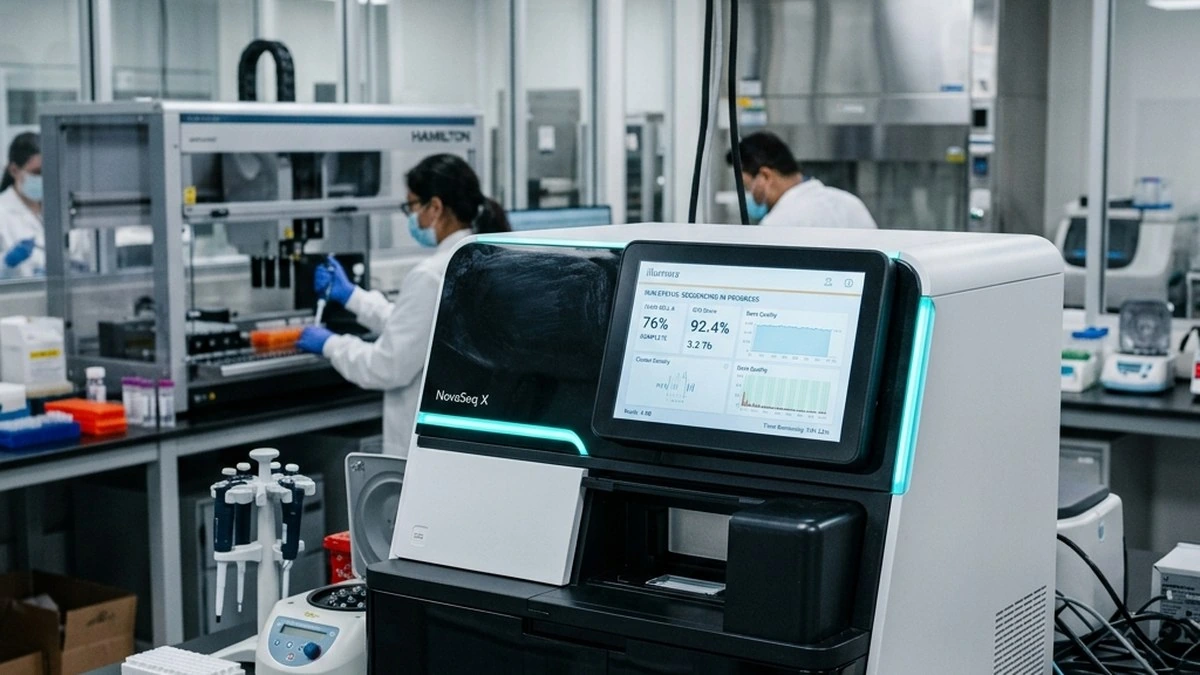
For more than a decade, the commercial next-generation sequencing (NGS) sector has functioned under the near-total market dominance of Illumina. While high-throughput core facilities celebrated the dramatic decline in sequencing costs from the early Human Genome Project, those low per-gigabase prices were locked behind multimillion-dollar capital equipment investments—forcing academic core labs into massive capital debt and rigid sample batching.
With the announcement of a 277 million Series D investment round, bringing its cumulative capital raised past680 million, San Diego-based Element Biosciences has solidified its position as the most disruptive challenger to the sequencing status quo. Led by Wellington Management, with substantial participation from Samsung E&A, Fidelity Management & Research, Venrock, and Foresite Capital, the funding will accelerate global commercial deployment of the AVITI benchtop sequencing system and fund the expansion of the multi-omics AVITI24 platform.
Challenging Market Dominance with Avidity Sequencing Chemistry #
Element's primary technological disruption stems from its complete re-engineering of the chemistry underlying short-read sequencing. Traditional sequencing-by-synthesis (SBS) relies on fluorescently labeled reversible terminators that bind sequentially to the growing DNA template. This approach demands high concentrations of expensive modified nucleotides, relies on bulky fluorophores that induce steric hindrance, and requires intensive wash steps that degrade signal quality over long read lengths.
Element bypassed these limitations by developing proprietary Avidity Sequencing™:
- Decoupling Binding from Catalysis: Instead of binding and incorporating labeled nucleotides simultaneously, Avidity Sequencing separates target recognition from nucleotide incorporation.
- Multivalent Avidity Probes: The platform utilizes multivalent probe complexes containing multiple dye molecules linked to a core scaffold. These complexes bind with high avidity to DNA rolling-circle amplification (RCA) clusters, generating intense fluorescent signal at nanomolar reagent concentrations.
- Reagent Cost Reduction: Because the avidity probes exhibit dramatically slower dissociation rates, the system requires less than 10% of the fluorescent dye and enzyme volume consumed in traditional SBS, slashing the consumable manufacturing cost per read.
- Polony Architecture: Utilizing rolling-circle replication (similar to Complete Genomics/MGI) rather than PCR-based bridge amplification avoids clonal propagation of polymerase errors, resulting in high accuracy exceeding 90% of bases scoring ge Q40 (one error per 10,000 bases).
Delivering the Sub-$200 Genome on a Flexible Benchtop Instrument #
The economic consequence of this chemical redesign is profound. Historically, achieving a 200 human genome required purchasing a1.2 million production-scale sequencer and loading dozens of genomes simultaneously onto a multi-terabase flow cell.
Element brought the $200 whole genome down to a compact benchtop footprint:
| Sequencing Platform | Capital Cost (Instrument) | Flow Cell Architecture | Maximum Yield per Run | Cost per Whole Genome (30×) | Accuracy Threshold |
|---|---|---|---|---|---|
| Illumina NextSeq 2000 | ~350,000 | Single flow cell | 360 Gb (1.2B reads) | ~450–600 | > 85%$ Q30 |
| Element AVITI | ~289,000 | Dual Independent Cells | 600 Gb (2.0B reads) | 200 (Cloudbreak High) | > 90% Q40 |
| Illumina NovaSeq X (1.5B) | ~950,000–1.25M | High-capacity dual | 1,500 Gb–16,000 Gb | 200 (at massive scale) | > 85%$ Q30 |
| PacBio Onso (SBB) | ~259,000 | Single flow cell | 100 Gb (400M reads) | ~800–1,000 | > 90%$ Q40 |
A critical operational differentiator is the AVITI's dual independent flow cell design. The two flow cells operate on completely separate fluidic lines and optical schedules. A laboratory can run a rapid 2 × 75 bp RNA-seq panel on Flow Cell A while simultaneously initiating a 2 × 150 bp whole-genome sequencing run on Flow Cell B—eliminating the need to batch dissimilar library types.
The AVITI24 Multimodal Architecture: Spatial Cyto-Profiling and DNA Runs #
The capital injection will directly fund the rollout of the AVITI24, an advanced platform that merges high-throughput sequencing with direct in situ cellular imaging on a single instrument.
Rather than processing extracted nucleic acids in bulk, the AVITI24 performs spatial multi-omics directly on intact biological samples:
- Morphological Phenotyping: The instrument captures high-resolution cellular morphology and subcellular structures using direct optical imaging.
- Targeted In Situ Transcriptomics: It measures the spatial expression of up to 500 targeted RNA transcripts per cell across millions of cells in a single run.
- Phospho-Protein Profiling: Multiplexed antibody-conjugated probes simultaneously quantify key phosphorylation signaling pathways directly alongside gene expression.
This unified architecture enables translational cancer researchers to link cellular morphology, signaling state, and transcriptomic identity without shipping samples across separate spatial biology and sequencing core facilities.
High-Profile Investor Backing and Global Support Expansion #
The participation of Samsung E&A alongside top-tier life sciences venture funds signals Element's expanding ambitions beyond academic genomics. The company is actively building regional field service, reagent warehousing, and technical application support hubs across Tokyo, Seoul, London, and Singapore to challenge Illumina's international dominance.
Crucially, partnerships with leading bioinformatics vendors (Sentieon, Google DeepVariant, DNAnexus) ensure that AVITI raw data integrates into standard clinical pipelines without custom code rewriting.
Benchtop Competitive Landscape and Long-Term Sequencing Economics #
The genomics marketplace has transitioned from a technology-constrained sector into an economics-driven market. By demonstrating that a $289,000 benchtop instrument can achieve lower consumable run costs and higher base-accuracy metrics than legacy room-sized sequencers, Element Biosciences has fundamentally disrupted the life sciences procurement cycle.
As the AVITI installed base expands across commercial reference laboratories, contract research organizations (CROs), and core facilities globally, competitive pressure is delivering substantial cost reductions to biomedical researchers worldwide.