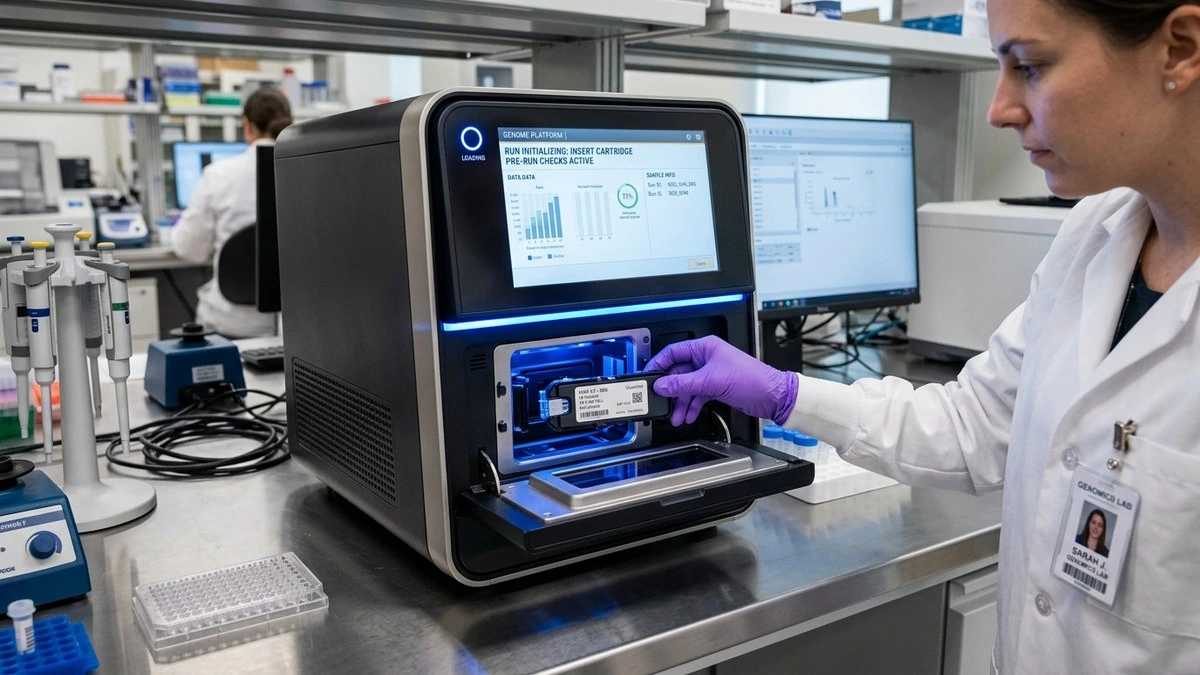
Illumina has formally introduced its next-generation benchtop sequencing architecture: the MiSeq i100 and MiSeq i100 Plus systems. Designed to decentralize clinical genomics and microbiology workflows, the new platforms introduce two critical industry breakthroughs: ambient-temperature reagent transport and same-day sequencing turnaround times under four hours.
Overcoming Dry-Ice Supply Chain Vulnerabilities #
For decentralized hospital labs, regional clinics, and international research facilities, the logistical dependency on -20circ ext{C} to -80circ ext{C} cold chains and dry-ice shipping has historically accounted for up to 18% of ancillary consumable costs. Reagent degradation due to courier delays, customs hold-ups, and thermal fluctuations has been a persistent failure point in low- and middle-income clinical settings.
The MiSeq i100 chemistry incorporates lyophilized, room-temperature stable polymerases and sequencing-by-synthesis (SBS) formulations, allowing cartridges to be shipped and stored at ambient temperature without cold-pack monitoring. Upon loading, an onboard automated fluidic reconstitution module hydrates the lyophilized master mixes with analytical-grade diluent, eliminating manual thaw protocols and reducing pre-run preparation to under 10 minutes.
Technical Performance & Throughput Benchmarks #
According to Illumina's published specification data, the system relies on an upgraded optical detection engine paired with miniaturized CMOS sensors:
- Run Time: Rapid modes deliver completed paired-end sequencing in under 4 hours, enabling same-shift turnaround from raw sample to secondary FASTQ analysis.
- Output Capacity: The standard MiSeq i100 outputs up to 25 million reads per run (5 Gb), while the i100 Plus scales to 100 million reads (20 Gb).
- Accuracy Profile: Incorporates XLEAP-SBS chemistry, achieving > 85% of bases scoring above Q30 across standard 2 imes 100 bp and 2 imes 150 bp read configurations.
- Consumable Footprint: Three-step workflow featuring pre-filled, single-use consumable cartridges requiring zero external fluidic line maintenance or post-run bleach washes.
Comparative Analytical Matrix #
To contextualize the operational leap over legacy architectures:
| Platform Specification | Legacy MiSeq v3 | MiSeq i100 Standard | MiSeq i100 Plus |
|---|---|---|---|
| Maximum Read Output | 25M paired reads | 25M single/paired | 100M paired reads |
| Maximum Data Yield | 15 Gb (2 imes 300 bp) | 5 Gb (2 imes 100 bp) | 20 Gb (2 imes 150 bp) |
| Run Duration | 24–56 hours | 3.8–4.5 hours | 7.5–9 hours |
| Shipping Temperature | Dry ice (-20circ ext{C}) | Ambient (15–30circ ext{C}) | Ambient (15–30circ ext{C}) |
| Onboard Primary Analysis | Real-Time Analysis (RTA) | DRAGEN onboard FPGA | DRAGEN onboard FPGA |
Expert Perspectives from the Bench #
"The transition to room-temperature stable chemistry represents a fundamental operational paradigm shift for clinical sequencing," said Dr. Marcus Vance, Director of Capital Equipment & Automation at BioScienceDesk. "Eliminating dry-ice dependence not only reduces freight expenditures and carbon footprint by more than 40%, but also removes the single greatest barrier to deploying rapid NGS in community hospital laboratories, regional pathology centers, and mobile biosurveillance units."
Dr. Katherine Meyer, Core Genomics Laboratory Director at a leading Midwestern academic health center, noted during the technical symposium: "Historically, running small targeted oncology or viral panels on large sequencers like the NovaSeq required batching patient samples for two to three weeks to justify flow-cell economics. With the MiSeq i100's four-hour cycle time and single-cartridge flexibility, our lab can process emergent neonatal sepsis or respiratory pathogen isolates on the same shift they arrive."
Lab Procurement & Economic Impact #
The MiSeq i100 directly targets decentralized microbiology, infectious disease surveillance, rapid oncology targeted panels, and small-batch QC laboratories that currently sub-contract small runs or batch samples for weeks to fill high-output NovaSeq flow cells. By offering a capital acquisition price point competitive with legacy MiSeq and MiniSeq instruments, Illumina is aggressively defending its benchtop installed base against rising competition from Element Biosciences' AVITI and Thermo Fisher's Ion Torrent platforms.
Commercial shipments to early-access clinical research customers in North America and Western Europe are underway, with full worldwide commercial availability scheduled for late October 2026.