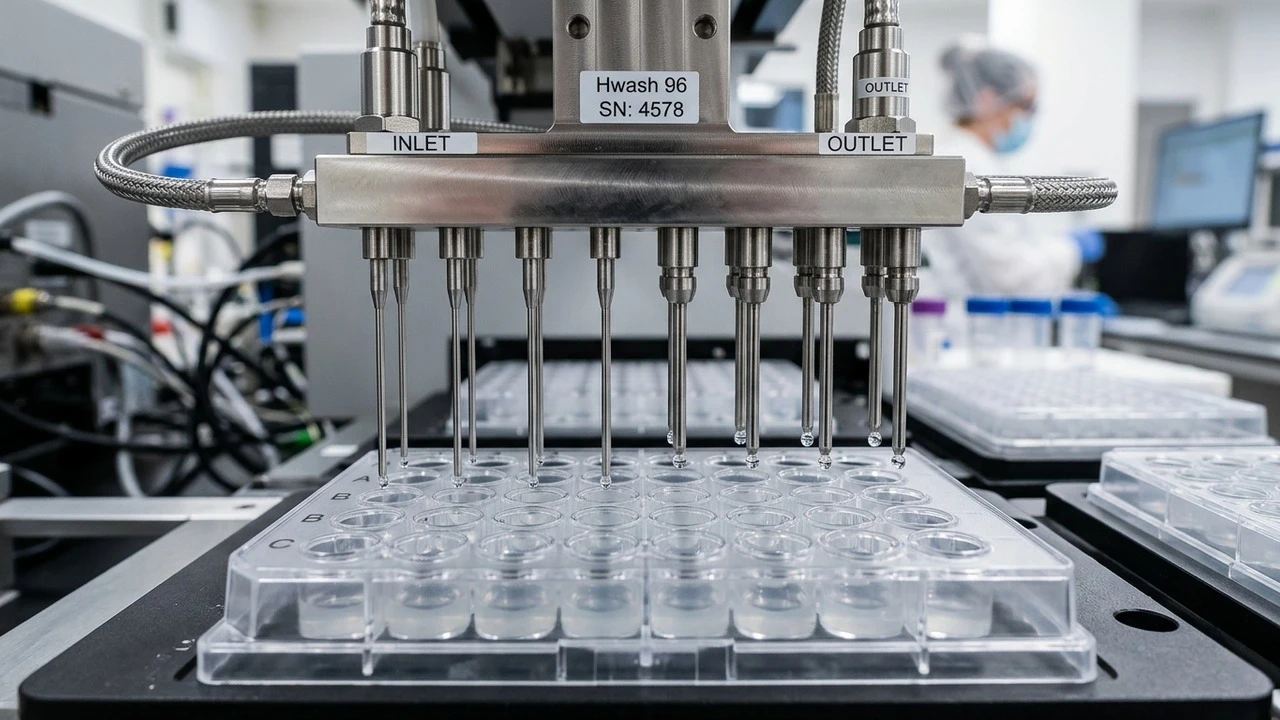
An assay standard curve drifts unexpectedly. Wells in column 12 read lower than column 1. The bench team checks multichannel pipettes, changes the wash buffer, and opens fresh reagent kits. Lost hours follow, while the reader's optical train remains uninspected.
Microplate readers undergo optical drift over time. Flash lamps degrade, monochromator grating drives develop backlash, and mirrors collect dust.
Liquid standards introduce their own problems into qualification. Well meniscus curvature varies with surface tension, fluid evaporation alters concentration over time, and pipetting volume variability can confound hardware qualification. Under these conditions, routine assay variability can be difficult to separate from reader optical drift.
Technician pipetting skill gets tested instead of the reader's internal optics.
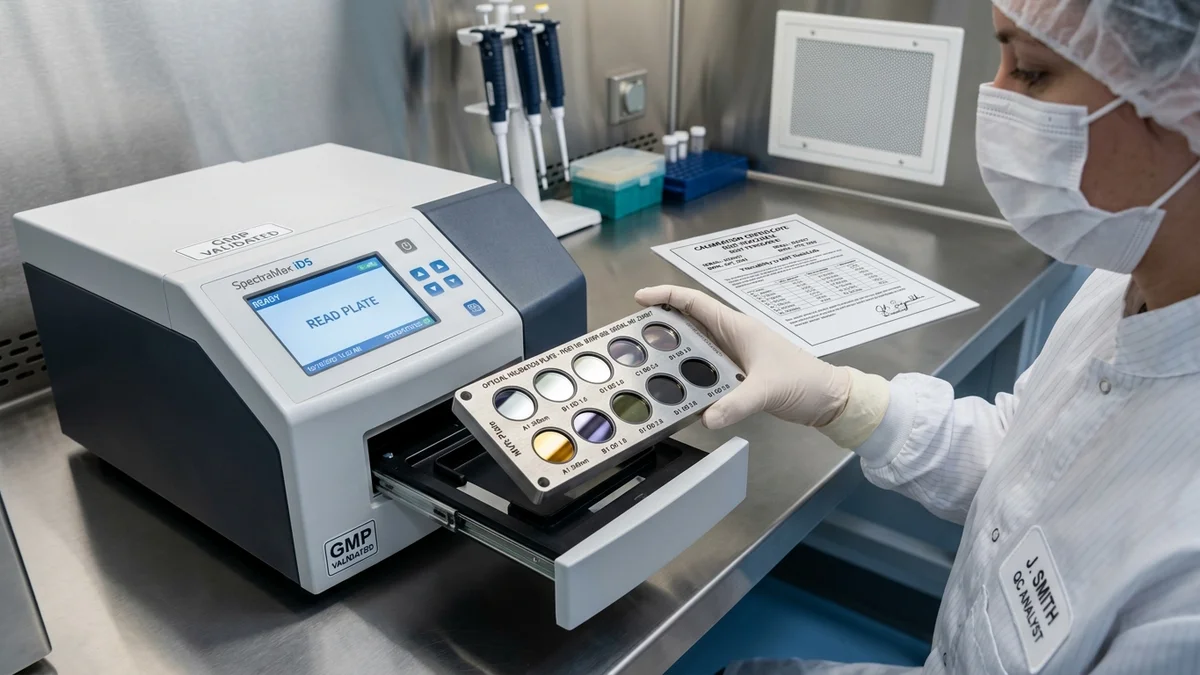
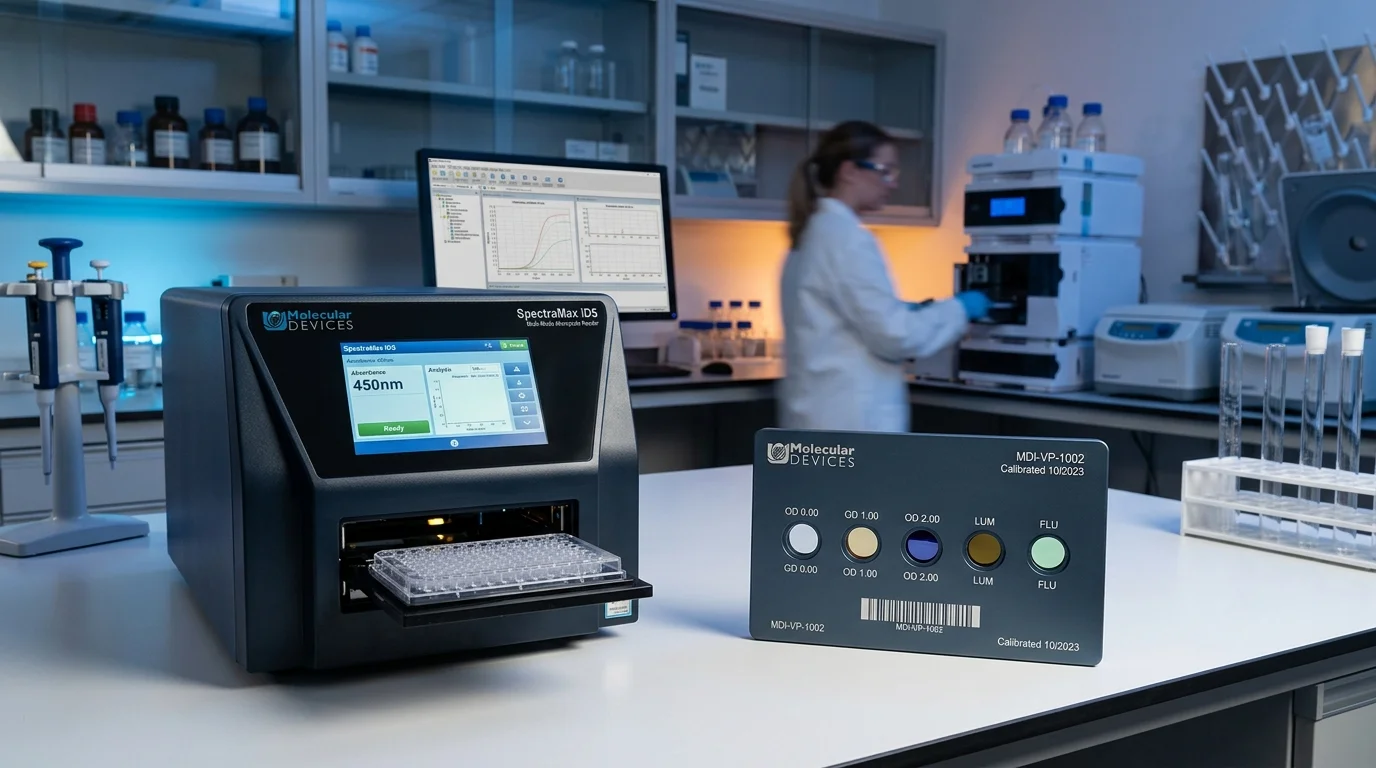
SpectraTest validation tools remove pipetting from the equation. Molecular Devices houses solid optical glass and reference standards inside solid aluminum blocks. The ABS2 checks absorbance, FL1 covers fluorescence, and LM1 measures luminescence. SoftMax Pro reads the filters, compares signals to certified factory values, and checks lamp output across wavelengths.
A validation plate tests hardware function, not overall analytical assay performance. It cannot detect sample autofluorescence or biological matrix interference. Its role is establishing that reader optics meet specification before assay plates enter the carriage.
1. Distinguishing Optical Verification, Instrument Qualification, and Calibration #
Analytical laboratories working under GLP, GMP, or laboratories accredited to ISO/IEC 17025 must maintain clear distinctions between three related operational tiers:
┌─────────────────────────────────────────────────────────────────────────────┐
│                       METROLOGICAL SCOPE IN GxP / ISO 17025                 │
├──────────────────────────────┬──────────────────────────────────────────────┤
│ Operation                    │ Technical Scope & Regulatory Role            │
├──────────────────────────────┼──────────────────────────────────────────────┤
│ Optical Performance          │ Testing whether specific hardware components │
│ Verification                 │ (lamp output, diffraction gratings, PMTs)    │
│                              │ respond within manufacturer specifications   │
│                              │ using certified transfer standards (ABS2).   │
├──────────────────────────────┼──────────────────────────────────────────────┤
│ Analytical Instrument        │ The standard 4Q framework (DQ, IQ, OQ, PQ)   │
│ Qualification (AIQ)          │ establishing that the reader is installed    │
│                              │ correctly, operates within limits, and fits  │
│                              │ the intended analytical purpose.             │
├──────────────────────────────┼──────────────────────────────────────────────┤
│ Accredited Calibration       │ Calibration performed by a laboratory        │
│                              │ accredited to ISO/IEC 17025 for the relevant │
│                              │ activity within its defined scope. The       │
│                              │ calibration result, associated uncertainty   │
│                              │ where applicable, and metrological           │
│                              │ traceability must be supported by the        │
│                              │ relevant calibration documentation.          │
└──────────────────────────────┴──────────────────────────────────────────────┘
A solid-state plate checks the optical train. It does not replace method validation, pathlength correction checks for aqueous solutions, or sample matrix recovery tests. Optical performance verification provides objective evidence that the reader's optical subsystems perform within design limits before clinical or biopharma assays begin.
2. Architecture and the Metrological Traceability Chain #
SpectraTest plates use precision-machined aluminum frames built to ANSI/SLAS microplate dimensions. Instead of liquid wells, the frames hold solid optical glass filters, calibrated synthetic reference materials, and precision apertures.
                      [ Multi-Mode Microplate Reader Optics ]
                                         │
         ┌───────────────────────────────┼───────────────────────────────┐
         ▼                               ▼                               ▼
   [ ABS2 Plate ]                  [ FL1 Plate ]                   [ LM1 Plate ]
   • Wavelength Accuracy           • Lower Limit of Detection      • Background Noise / Dark
   • Photometric Accuracy          • Ex/Em Wavelength Accuracy     • Transient Signal Spikes
   • Photometric Precision         • PMT Matching / Gain           • Lower Limit of Detection
   • Photometric Linearity         • Top vs. Bottom Read Bias      • Luminescence Crosstalk
   • Stray Light Evaluation        • Kinetic Noise & Drift         • Dynamic Range Linearity
   • Optical Beam Centering        • Well-to-Well Reproducibility  • Relative Light Units (RLU)
Documented Traceability Relationships
SpectraTest validation plates function as secondary transfer standards calibrated by an ISO/IEC 17025 accredited facility within its defined scope, with physical traceability documented on the Certificate of Calibration accompanying each plate:
- Photometric Transmission Scale: Calibrated against neutral-density glass transmission standards with photometric scale traceability to primary national metrology standards (such as NIST SRM 930/1930 series, as documented on the plate calibration certificate).
- Spectral Wavelength Scale: Wavelength calibration references intrinsic absorption band positions (such as certified holmium oxide reference standards, documented on the plate certificate).
- Metrological Guidance: Testing principles align with standard optical qualification methodologies, including frameworks described in NISTIR 7458 (Standard Guide to Fluorescence — Instrument Calibration and Validation) for fluorescence measurement qualification.
- Validation Plate Recertification: Optical filter surfaces accumulate particulates, and optical properties can undergo environmental shifts over extended use. Molecular Devices recommends factory ISO/IEC 17025 recertification of the validation plates at one-year intervals to renew calibration certificates and update SoftMax Pro certificate files.
3. ABS2 Absorbance Validation: Photometric & Spectral Testing #
The ABS2 plate qualifies UV-Visible absorption optics across reader-supported wavelengths using instrument-specific SoftMax Pro protocols and individual certificate values:
A. Wavelength Accuracy and Precision
These tests evaluate wavelength-selection accuracy and repeatability using the applicable instrument-specific SoftMax Pro validation protocol and assigned reference values. Acceptance criteria must follow the relevant reader specifications and plate Certificate of Calibration. SoftMax Pro runs automated spectral acquisition routines across designated peaks to compare measured peak wavelengths directly against the certificate values. Precision is evaluated through repeated spectral scans to verify wavelength-selection repeatability within protocol limits.
B. Photometric Accuracy and Precision
Photometric accuracy evaluates whether measured Optical Density (OD) corresponds to the certified filter transmission:
- Tolerances: Acceptance limits are defined in reader-specific SoftMax Pro protocol files using the plate's certificate values and reader model specifications, scaling across optical density levels.
- Photometric Precision: Computed from consecutive optical measurements on reference filters to verify flash reproducibility and detector stability.
C. Photometric Linearity
Linearity evaluates detector dynamic range across increasing optical densities using a stepped progression of neutral-density glass filters. SoftMax Pro performs mathematical regression and residual analysis, verifying that detector response remains linear across the working range without premature saturation.
D. Stray Light Evaluation
This test evaluates monochromatic light purity and out-of-band optical radiation reaching the detector, which can induce negative photometric errors at elevated optical densities. Acceptance criteria and test interpretations are determined according to the reader-specific SoftMax Pro validation protocol.
E. Optical Beam Centering
Machined aperture pinholes verify XY stage positioning relative to the optical read head, ensuring the illumination beam centers directly through microplate wells without clipping well sidewalls.
4. FL1 Fluorescence Validation: Performance Domains #
Fluorescence quantification relies on Relative Fluorescence Units (RFU) that depend on lamp pulse energy, PMT gain voltages, optical filter bandpass, and fiber-optic collection geometry. Solid-state fluorescent reference materials reduce the concentration instability, photobleaching, and evaporation typical of liquid dye solutions.
Depending on the specific SpectraMax model, optical architecture (monochromator vs. filter-based), and supported read modes, SoftMax Pro protocols evaluate key fluorescence performance domains documented in the official manufacturer test inventory:
- Lower Limit of Detection (LLD): Evaluates low-concentration fluorophore emission relative to background noise as defined by the instrument qualification protocol.
- Excitation / Emission Wavelength Accuracy: Evaluates monochromator grating calibration across excitation and emission optical paths where supported.
- Wavelength Precision: Checks spectral reproducibility across repeated excitation and emission scans.
- PMT Matching & Voltage Linearity: Tests signal amplification across gain settings and high-voltage configurations.
- Top-to-Bottom Read Path Bias: Compares top and bottom optical channels for readers equipped with dual optical paths.
- Kinetic Noise, Spikes & Drift: Measures emission signal across consecutive reads to verify that repeated excitation pulses do not induce transient signal instability or temporal drift.
- Well-to-Well Reproducibility: Confirms that the optical read head generates consistent RFU values across symmetrical well positions.
- RFU Linearity & Scale Ratio: Evaluates signal response linearity and scale ratios across stepped fluorophore standards as defined in the protocol.
5. LM1 Luminescence Validation: Dark Count & Crosstalk Control #
Luminescence assays (such as ATP bioluminescence and dual-luciferase reporter assays) do not use an excitation light source. The reader functions as an ultra-sensitive photon detector.
The LM1 plate holds calibrated solid-state luminescent standards to evaluate performance domains documented in instrument-specific validation protocols:
- Background Noise & Dark Counts: Measures baseline electronic noise in light-tight cavities to detect elevated electronic background or enclosure light leaks.
- Transient Signal Spikes & Anomalies: Detects transient electronic anomalies or signal spikes during read cycles.
- Lower Limit of Detection (LLD): Evaluates the lower limit of photon detection above dark count baseline.
- Optical Crosstalk Isolation: Evaluates optical masking and aperture baffles by measuring light leakage from high-signal luminescent cavities into adjacent dark cavities according to protocol geometry.
- Linearity Across Dynamic Range: Tests signal linearity across increasing luminescent intensity standards.
- Relative Light Unit (RLU) Response: Confirms consistent photon detection response parameters as evaluated by the protocol.
- Spatial Channel Bias & Well-to-Well Precision: Evaluates optical uniformity and channel alignment across plate carrier coordinates.
Note: Supported test configurations vary depending on reader hardware and whether top or bottom read modes are equipped.
6. SoftMax Pro GxP Workflows & Regulatory Compliance Boundaries #
In regulated laboratories, instrument qualification records must be controlled and auditable. SoftMax Pro GxP works alongside SpectraTest plates through standardized validation protocols:
┌─────────────────────────────────────────────────────────────────────────────┐
│                   SOFTMAX PRO GXP VALIDATION WORKFLOW                       │
└─────────────────────────────────────┬───────────────────────────────────────┘
                                      ▼
             [ Import Certified Plate Data (Protocol / EZinCert) ]
               • Plate serial number & expiration date recorded
               • Certificate values imported into secured template
                                      ▼
                  [ Automated Multi-Wavelength Read Run ]
               • Pre-programmed microplate read protocols
               • Reader serial number recorded automatically
                                      ▼
               [ Automated Pass/Fail Algorithm Execution ]
               • Mathematical deltas, regressions & standard deviations
               • Tolerance comparisons executed against certificate limits
                                      ▼
               [ Regulated Electronic Record Generation ]
               • Secure, time-stamped audit trail entries created
               • Configurable electronic signatures applied (e.g. Author/Reviewer)
               • Secure, printable qualification dossier archived
Regulatory Compliance Boundaries
While SoftMax Pro GxP provides technical controls—such as role-based user access, secure time-stamped audit trails, and data protection features—software alone does not confer automatic regulatory compliance. Complete FDA 21 CFR Part 11 and EU Annex 11 compliance requires an established laboratory quality management framework, including computer system validation (CSV), documented user administration procedures, standard operating procedures governing electronic signatures, and secure backup systems.
7. Benchtop Troubleshooting: Investigating Validation Failures #
When a microplate reader fails a SpectraTest validation parameter, laboratory teams should evaluate potential bench-level causes systematically before requesting service interventions:
Case 1: ABS2 Wavelength Accuracy Fails at UV Wavelengths
- Observation: Holmium oxide UV peaks fail tolerance, while visible peaks pass.
- Hypotheses to Investigate: Possible decay in xenon flash lamp UV output due to aging or electrode envelope degradation. Reduced UV light intensity decreases detector signal-to-noise ratio. Check lamp usage metrics in SoftMax Pro diagnostics and consult manufacturer service guidance if lamp replacement is indicated.
Case 2: Photometric Accuracy Fails High Across Filters
- Observation: Measured optical density reads uniformly higher than certified values across multiple neutral-density filters.
- Hypotheses to Investigate: Surface particulate contamination or fingerprints on optical filters. Dust scatters light, artificially inflating apparent optical density. Consult the official SpectraTest User Guide for plate-specific handling and maintenance instructions—avoiding touching optical surfaces, immersion in fluids, abrasive wipes, or unauthorized disassembly.
Case 3: Stray Light Test Out of Specification
- Observation: Elevated transmission detected in the cutoff zone.
- Hypotheses to Investigate: Potential microplate drawer perimeter light leaks, worn chassis seals, or internal optical surface contamination from volatile laboratory chemicals (such as DMSO or acid fumes from unsealed assay plates). Inspect the drawer perimeter gasket for light seals.
Case 4: FL1 or LM1 Crosstalk Out of Specification
- Observation: Excess signal detected in blank wells adjacent to high-intensity reference standards.
- Hypotheses to Investigate: Potential plate carrier alignment issues, improper plate seating, or read head positioning mechanisms as specified in the instrument manual.
8. Qualification and Verification Schedule #
The frequency of optical performance verification and instrument qualification should be established in a documented, risk-based laboratory procedure. Relevant considerations include intended use, assay criticality, manufacturer recommendations, instrument history, observed performance trends, maintenance and service interventions, and applicable regulatory requirements.
Optical performance verification may be scheduled periodically (such as monthly or quarterly health checks defined by laboratory SOPs) and should be conducted following service or optical interventions. The laboratory should define appropriate acceptance criteria, document results and deviations, and establish corrective actions when criteria are not met.
Analytical instrument qualification—including design qualification where applicable, installation qualification, operational qualification, and performance qualification—should be managed through the laboratory's approved qualification lifecycle. A SpectraTest pass provides supporting evidence of specified optical performance; it does not, by itself, demonstrate completion of all qualification activities.
Molecular Devices recommends recertifying SpectraTest validation plates at one-year intervals. The laboratory should follow applicable manufacturer instructions and certificate conditions when managing plate recertification and traceability.