The Downstream Panic: When Permeate Flux Collapses #
If you run downstream purification in a biopharma pilot plant or commercial suite, you know the exact minute a tangential flow filtration run starts going south.
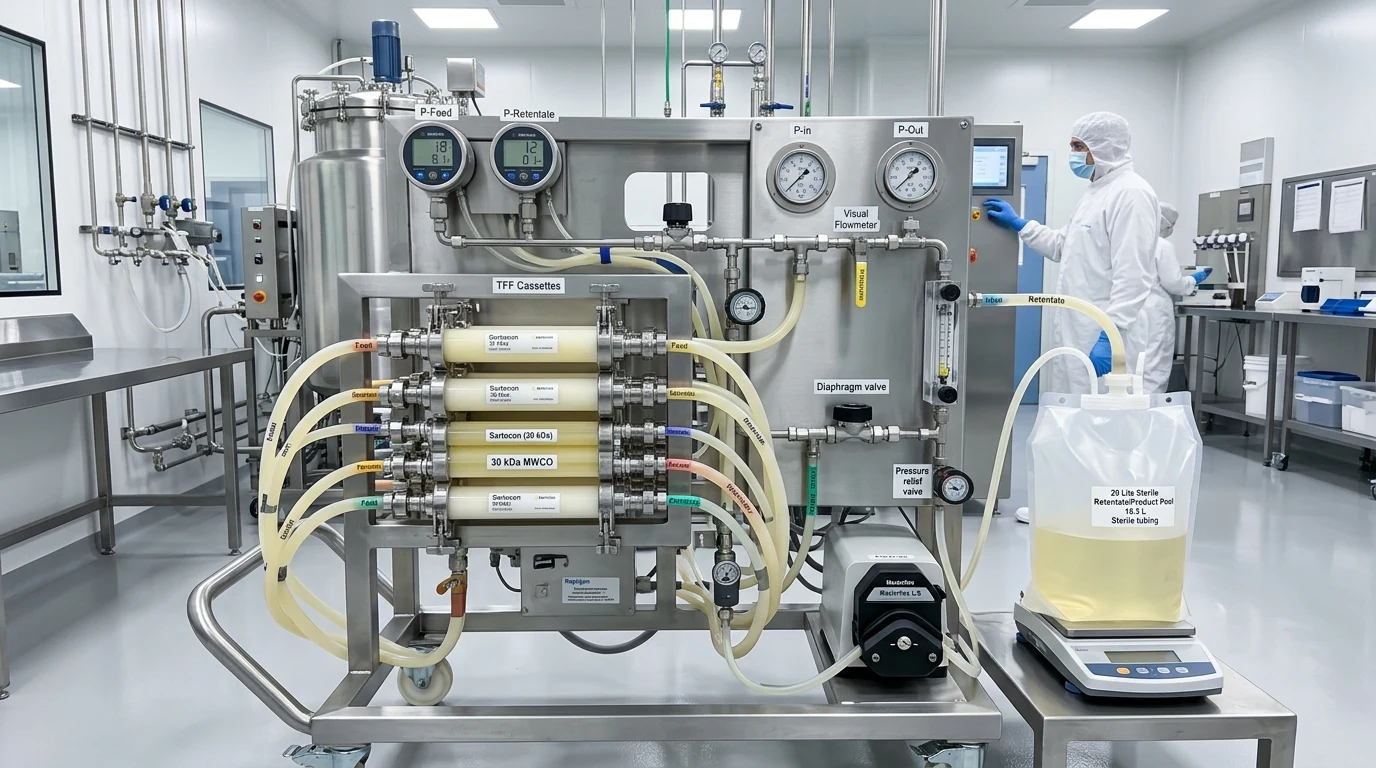
You are eight hours into a final concentration and diafiltration step on a high-titer monoclonal antibody. The target is 150 grams per liter in a 30-kilodalton regenerated cellulose cassette. Everything looked textbook during the initial five-fold volumetric concentration. Then, thirty minutes into diafiltration against histidine buffer, the permeate flow rate drops by half.
What is the first reflex of a junior bioprocess tech? They reach for the feed pump controller and dial up the speed to force more liquid across the membrane.
Do not touch that speed knob. That is the single most expensive mistake you can make on an ultrafiltration skid.
When permeate flux decays in tangential flow filtration, pushing higher feed pressure does not give you more throughput. In fact, it does the exact opposite. It compacts the protein gel layer against the membrane surface, drives irreversible fouling into the pores, and can shear your antibody into high-molecular-weight aggregates within minutes.
Understanding what is actually happening at the membrane wall comes down to three operational levers: transmembrane pressure, crossflow shear rate, and gel layer mass transfer.
The Trap of Transmembrane Pressure (TMP) #
Let's review the pressure math every downstream operator should calculate in their head:
Transmembrane pressure equals the average of feed pressure and retentate pressure, minus the permeate pressure:
When you start filtering a dilute feed stream—say, 5 grams per liter straight out of anion-exchange chromatography—the membrane operates in what chemical engineers call the pressure-dependent flux regime. If you increase TMP from 0.5 bar to 1.2 bar, permeate flux climbs linearly. Solvent and buffer salts zip through the 30 kDa pores while your 150 kDa IgG molecules sweep across the membrane face and return to the retentate tank.
Crossflow velocity is what keeps the membrane alive. The feed stream does not slam perpendicular into the filter face like dead-end sterile filtration; it sweeps tangentially across the channels at shear rates between 4,000 and 6,000 inverse seconds (s-1). That lateral scouring sweeps rejected protein molecules back into the bulk retentate stream.
Operational Parameters Across Filtration Regimes #
| Engineering Parameter | Pressure-Dependent Regime (Low Concentration) | Pressure-Independent Regime (Gel Layer Wall) |
|---|---|---|
| Protein Feed Concentration | 1 to 30 g/L (initial volumetric concentration) | 80 to 200+ g/L (final formulation target) |
| Permeate Flux Response | Flux climbs proportionally with TMP increase | Flux plateaus; higher TMP causes gel cake compaction |
| Dominant Resistance | Intrinsic hydraulic resistance of clean membrane (Rm) | Boundary-layer gel resistance (Rg) + fouling cake (Rf) |
| Primary Process Control | Regulate TMP via retentate throttle valve | Regulate crossflow shear velocity to sweep boundary layer |
| Shear Aggregation Liability | Low (low bulk solution viscosity, minimal friction) | High (hydrodynamic shear triggers sub-visible particles) |
The Gel Layer Transition: Why More Pump Power Backfires #
As your protein concentrates from 20 grams per liter toward 100 grams per liter, something critical shifts at the membrane boundary. Protein molecules accumulate faster than crossflow shear can sweep them away. This is concentration polarization.
Eventually, the protein concentration at the membrane surface hits a critical limit—often between 250 and 350 grams per liter for standard IgG1 molecules. At that wall concentration, the protein forms a viscous, hydraulic gel layer.
Once that gel forms, you enter the pressure-independent flux regime.
If you increase the feed pump speed or choke down the retentate control valve to raise TMP, you do not force more water through the pores. Instead, you hydraulically compress that protein gel into a tighter cake. The hydraulic resistance of the cake jumps exponentially, exactly counteracting your pressure increase. Your permeate flux stays flat or actually decreases, while your pump dumps massive mechanical shear into the protein solution, spiking turbidity and sub-visible particles.
How to Dial in the Optimal TMP Excursion #
Before you freeze your commercial manufacturing batch record, you have to run a proper flux excursion trial on a small-scale flat-sheet cassette (like a 0.01 square meter bench unit).
Here is how we run it on the development bench:
Set your crossflow feed rate to your baseline target—typically 300 to 450 liters per square meter per hour (LMH). Start with your retentate valve wide open so TMP is near 0.3 bar. Record the permeate flux. After five minutes of stabilization, pinch the retentate valve slightly to step TMP up by 0.3 bar increments: 0.6 bar, 0.9 bar, 1.2 bar, 1.5 bar, and 1.8 bar.
Plot permeate flux on the vertical axis against TMP on the horizontal axis. You will see a clear linear climb, followed by a plateau knee. Your operating TMP should always be locked at eighty percent of that knee point. That twenty percent safety margin keeps your process comfortably inside the sustainable pressure-dependent window, preventing gel compaction even if batch viscosity drifts by ten or fifteen percent.
Diafiltration Dynamics: The 7-Volume Rule #
Once you concentrate the bulk pool to your intermediate target, you switch to diafiltration (DF) to exchange the cell culture or chromatography buffer into your final formulation matrix—typically a low-ionic-strength histidine, sucrose, and polysorbate blend at pH 5.5 to 6.0.
How many diavolumes do you need?
The theoretical wash-out equation is straightforward:
where N is the number of diavolumes, C0 is initial buffer salt concentration, and CN is residual concentration.
- At 5 diavolumes, you remove roughly 99.3% of the original buffer salts.
- At 7 diavolumes, you hit 99.9% clearance.
Running beyond 7 or 8 diavolumes is rarely justified unless you are removing a toxic viral inactivating detergent like Triton X-100 or high concentrations of guanidine hydrochloride. Every extra diavolume subjects your protein to additional pump passes, increasing the cumulative shear stress and risk of interfacial air denaturation in the feed vessel.
Cleaning in Place (CIP) and Normalized Water Permeability #
Membrane cassettes are major capital items. A bank of five 2.5-square-meter cassettes can easily run thirty to fifty thousand dollars. You cannot treat them as single-use disposables in commercial production.
To prove your cleaning cycle works between batches, you track Normalized Water Permeability, or NWP:
Before you touch any product to a new cassette, you measure clean water flux across the membrane using pure water for injection (WFI) at a fixed temperature (usually 20 degrees Celsius) and a reference TMP of 1.0 bar. That baseline NWP is your cassette's fingerprint.
After your product run, you flush residual protein with WFI, then circulate 0.1 to 0.5 Molar sodium hydroxide at 40 to 45 degrees Celsius for 45 to 60 minutes. The hot caustic solution hydrolyzes and solubilizes adsorbed protein films.
If post-CIP water testing shows NWP recovery below eighty percent of the initial virgin baseline, your membrane is fouled. You either run an extended sanitization cycle with formulated detergents, or you retire the cassette bank before it wrecks yield on your next production lot.