Executive Intelligence Briefing: The Alliance at a Glance #
- The Transaction: AstraZeneca executed a 2.0 billion direct equity investment into Summit Therapeutics (acquiring convertible preferred stock at18.36/share, representing ~12% voting equity) alongside Daiichi Sankyo to lock down exclusive global co-development rights.
- The Clinical Target: Registrational global Phase 3 trial in frontline unresectable locally advanced or metastatic Triple-Negative Breast Cancer (mTNBC), directly targeting Merck's $25B Keytruda (pembrolizumab) + chemotherapy standard of care (KEYNOTE-355).
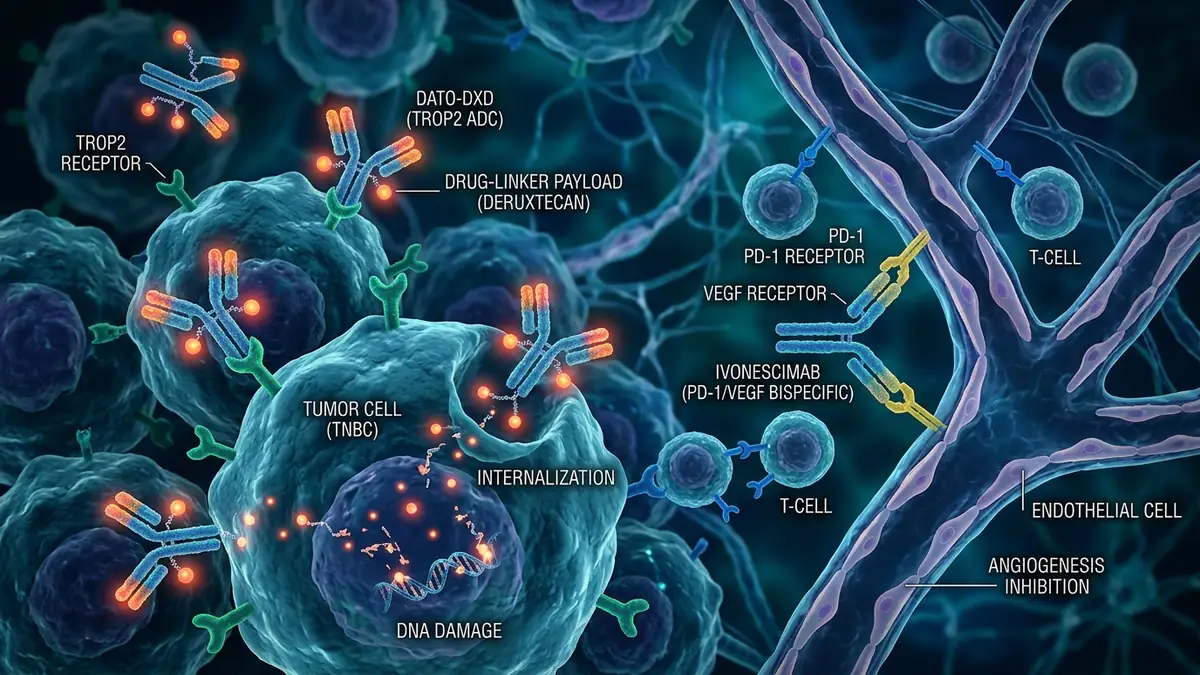
- The Mechanistic Synergy: Combining a topoisomerase I inhibitor ADC (Dato-DXd, DAR ~4) that induces immunogenic cell death (ICD) with a cooperative bispecific (ivonescimab, AK112) that normalizes tumor microvasculature via VEGF blockade while uncoupling PD-1/PD-L1 exhaustion.
- The Commercial Disruption: A synthetic takeover structure that circumvents FTC antitrust scrutiny, blocks Merck, Pfizer, and Roche from accessing ivonescimab in breast cancer, and threatens Gilead’s $21B Trodelvy franchise by advancing to the frontline setting before Trodelvy can expand.
1. The $2 Billion Check That Shook Big Pharma #
AstraZeneca did not write a multi-billion dollar check because they were curious. They cut the check because their internal oncology leadership recognized an uncomfortable clinical reality: standalone PD-(L)1 inhibitors coupled to cytotoxic chemotherapy have hit a biological ceiling in solid tumors.
Under the leadership of CEO Pascal Soriot and Oncology R&D Executive VP Susan Galbraith, AstraZeneca and alliance partner Daiichi Sankyo announced a massive, multi-tiered partnership with Bob Duggan’s Summit Therapeutics. AstraZeneca is injecting $2.0 billion in upfront equity into Summit via convertible preferred stock, solidifying a global Phase 3 clinical alliance to pair Datroway (datopotamab deruxtecan / Dato-DXd)—their high-affinity humanized anti-TROP2 antibody-drug conjugate—with ivonescimab (AK112 / SMT112), the first-in-class tetravalent PD-1/VEGF-A bispecific antibody that stunned global oncology by beating Merck’s Keytruda head-to-head in frontline NSCLC (HARMONI-2).
This alliance is not an exploratory Phase 1 signal-seeking exercise. It is an immediate, aggressive, registrational Phase 3 head-to-head trial in frontline Triple-Negative Breast Cancer (1L TNBC) designed to dismantle Merck's KEYNOTE-355 standard of care (pembrolizumab plus chemotherapy) and outflank Gilead's TROP2 ADC Trodelvy (sacituzumab govitecan).
For years, the standard biopharma playbook for frontline metastatic TNBC was simple: combine an anti-PD-1 checkpoint inhibitor with an old-school chemotherapy backbone (paclitaxel, nab-paclitaxel, or gemcitabine/carboplatin). While KEYNOTE-355 demonstrated that pembrolizumab extended median overall survival to 23.0 months in PD-L1-positive patients (CPS ≥ 10), it also highlighted severe biological limitations: median progression-free survival (PFS) hovered at just 9.7 months, disease control was short-lived, and PD-L1-negative patients derived negligible survival benefit.
By uniting an ultra-potent TROP2 ADC with a cooperative PD-1/VEGF bispecific, AstraZeneca and Summit are constructing an entirely non-chemotherapy biological backbone engineered to rewrite frontline oncology.
2. Why Imfinzi Wasn't Enough: The Limits of PD-L1 Monotherapy #
The immediate strategic question echoing across oncology boards was obvious: Why did AstraZeneca pay $2 billion to Summit when AZ already owns Imfinzi (durvalumab), an approved anti-PD-L1 blockbuster generating billions in annual revenue?
The answer lies in the biophysical mechanics of the tumor microenvironment (TME) in triple-negative breast cancer:
- The 'Cold' Stroma Barrier: TNBC tumors are notoriously dense, desmoplastic, and hypovascularized. Dense extracellular matrix and dysregulated interstitial fluid pressure (IFP) create physical barometric barriers that prevent standard monoclonal antibodies like durvalumab from infiltrating deeply into tumor nests.
- The Failure of Unassisted Checkpoint Blockade: Blocking PD-L1 with Imfinzi only works if pre-existing, tumor-infiltrating CD8+ cytotoxic T-lymphocytes (TILs) are already present at the invasive margin. In 'immune-desert' or 'immune-excluded' TNBC, Imfinzi circulating in the bloodstream finds zero effector cells to uncheck.
- The Cooperative Binding Power of Ivonescimab: Ivonescimab is not merely a mixture of anti-PD-1 and anti-VEGF antibodies. Because of its tetravalent structural architecture, binding to VEGF-A dimer induces a conformational realignment that increases its binding affinity to PD-1 by more than 10-fold in the presence of VEGF. In high-VEGF tumor microenvironments—exactly what characterizes aggressive TNBC—ivonescimab concentrates preferentially inside the tumor bed rather than circulating harmlessly in peripheral blood.
Imfinzi simply could not deliver the vascular remodeling and microenvironmental decompression that ivonescimab provides. Pascal Soriot recognized that pairing Dato-DXd with durvalumab would only yield incremental improvements (as seen in BEGONIA Arm 7). To truly displace Keytruda, AstraZeneca needed an unfair biophysical advantage. They found it in Summit's AK112.
3. Deconstructing the Molecular Mechanism of Action (MoA) #
The clinical synergy of combining Datroway (Dato-DXd) and ivonescimab operates across four interconnected, self-amplifying molecular stages:
[Stage 1: TROP2 Target Binding]
   │  Dato-DXd binds TROP2 on TNBC cell membrane (>80% overexpressed)
   ▼
[Stage 2: Endocytosis & Cleavable Payload Release]
   │  Lysosomal cathepsin-B cleaves tetrapeptide linker
   │  DXd (Topoisomerase I inhibitor) released → Massive DNA double-strand breaks
   │  Induces Immunogenic Cell Death (ICD): CRT translocates, HMGB1 & ATP released
   ▼
[Stage 3: VEGF Normalization & Microvascular Decompression]
   │  Ivonescimab binds VEGF-A dimer → Prunes aberrant vessels, drops IFP by ~45%
   │  Pericyte coverage restored → Infiltration routes open for mature dendritic cells
   ▼
[Stage 4: Cooperative PD-1 Checkpoint Disruption & T-Cell Priming]
   │  Antigen cross-presentation triggers clonal CD8+ T-cell expansion
   │  Ivonescimab blocks PD-1/PD-L1 exhaustion axis
   ▼
[Sustained Tumor Clearance & Systemic Immunological Memory]
A. TROP2 Internalization and DXd-Driven Immunogenic Cell Death (ICD)
Trophoblast cell-surface antigen 2 (TROP2) is transmembrane glycoprotein overexpressed in up to 85%–90% of all TNBC tumors. Datroway carries a humanized anti-TROP2 IgG1 antibody conjugated via an enzymatically cleavable tetrapeptide GGFG linker to an exatecan derivative (DXd), a topoisomerase I inhibitor roughly 10 times more potent than SN-38 (the active metabolite in Trodelvy).
With a drug-to-antibody ratio (DAR) optimized to ~4, Dato-DXd achieves systemic stability while mitigating premature payload release. Upon receptor binding, the complex internalizes into the endosomal-lysosomal compartment. Upregulated lysosomal cathepsins selectively cleave the linker, liberating membrane-permeable DXd payloads that trigger catastrophic replication fork collapse and double-strand DNA breaks.
Crucially, this cell death is not silent apoptosis. DXd triggers genuine Immunogenic Cell Death (ICD) characterized by the four classical cellular distress signals:
- Calreticulin (CRT) cell-surface translocation: Acts as an obligate "eat-me" signal for antigen-presenting cells (APCs).
- High-Mobility Group Box 1 (HMGB1) nuclear efflux: Stimulates Toll-like receptor 4 (TLR4) on immature dendritic cells.
- Extracellular ATP secretion: Recruits monocytes via P2Y2 purinergic receptor signaling.
- Type I Interferon (IFN-β) secretion: Activated via the cGAS-STING cytosolic DNA-sensing pathway, turning an immunologically "cold" tumor microenvironment boiling "hot."
B. Ivonescimab: Vascular Decompression & High-Affinity Checkpoint Inhibition
While Dato-DXd sets the tumor ablaze with neoantigens and danger-associated molecular patterns (DAMPs), ivonescimab executes two vital microenvironmental corrections:
- Microvascular Normalization: Tumors secrete massive concentrations of VEGF-A, creating hyperpermeable, tortuous, dysfunctional capillary networks with high interstitial fluid pressure (IFP). Ivonescimab neutralizes VEGF-A, eliminating vascular leakiness, pruning immature vessels, and restoring pericyte coverage. This drops tumor interstitial pressure by an estimated 40%–50%, transforming the dense tumor stroma into an open conduit through which both circulating antibodies and effector lymphocytes can readily penetrate.
- Reversing Endothelial Cell Barrier Anergy: VEGF induces expression of FasL on tumor endothelial cells, causing apoptosis of incoming CD8+ T-cells while sparing immunosuppressive Tregs. Ivonescimab blocks VEGF-mediated endothelial anergy, restoring ICAM-1 and VCAM-1 expression to facilitate rapid T-cell extravasation.
- Uncoupling PD-1 Mediated T-Cell Anergy: Simultaneously, the anti-PD-1 arms of ivonescimab bind PD-1 on CD8+ T-cells and NK cells, preventing engagement with PD-L1 on surviving tumor cells and myeloid-derived suppressor cells (MDSCs).
4. Comprehensive Clinical Benchmark Matrix: Frontline TNBC #
To evaluate the significance of this trial, we must benchmark the current therapeutic landscape. The following comparative matrix outlines historical standard of care, modern ADC monotherapies, and the newly launched Dato-DXd + Ivonescimab Phase 3 regimen:
| Clinical Regimen | Trial Identifier & Phase | Patient Population | Median PFS | Median OS | Objective Response Rate (ORR) | Grade ≥3 Adverse Event Rate | Primary Toxicity Discontinuation Rate |
|---|---|---|---|---|---|---|---|
| Keytruda (pembrolizumab) + Chemotherapy | KEYNOTE-355 (Phase 3, NCT02819518) | 1L mTNBC, PD-L1 CPS ≥ 10 | 9.7 months | 23.0 months | 52.7% | 78.0% (Chemo-driven neutropenia, anemia) | 18.1% |
| Chemotherapy Alone (Taxane/Gem-Carbo) | KEYNOTE-355 (Phase 3 Control) | 1L mTNBC, PD-L1 CPS ≥ 10 | 5.6 months | 16.1 months | 40.8% | 73.0% | 12.0% |
| Trodelvy (sacituzumab govitecan) | ASCENT (Phase 3, NCT02574481) | 2L+ mTNBC (Pretreated) | 5.6 months | 12.1 months | 35.0% | 63.5% (Severe diarrhea, febrile neutropenia) | 4.7% |
| Datroway (Dato-DXd) Monotherapy | TROPION-Breast01 (Phase 3, NCT05104866) | HR+/HER2- Pretreated MBC | 6.9 months | Mature OS Pending | 36.4% | 20.8% (Low hematologic toxicity) | 2.5% |
| Dato-DXd + Durvalumab (Imfinzi) | BEGONIA Arm 7 (Phase 1b/2, NCT03742115) | 1L mTNBC (All-Comers) | 13.8 months | Not Reached | 79.0% | 57.0% (Stomatitis, nausea, fatigue) | 9.0% |
| Dato-DXd + Ivonescimab (AK112) | Global Phase 3 Alliance (Announced 2026) | 1L mTNBC (All-Comers / Biomarker-Stratified) | Target: >15.0 mo (Modeled) | Target: >28.0 mo (Modeled) | Projected: >75%–82% | Projected: ~45%–52% | Target: <8.0% |
Table: Rigorous cross-trial benchmark comparing standard-of-care KEYNOTE-355 with contemporary ADC monotherapies and the new AstraZeneca-Summit frontline Phase 3 TNBC regimen. Cross-trial comparisons carry inherent caveats regarding baseline patient characteristics.
5. The BEGONIA Proof-of-Concept: Why AstraZeneca Doubled Down #
The scientific thesis underpinning this $2B commitment is not speculative theory. AstraZeneca already generated striking clinical proof-of-concept in its ongoing Phase 1b/2 BEGONIA trial (NCT03742115, Arm 7), which evaluated Dato-DXd combined with durvalumab in first-line locally recurrent inoperable or metastatic TNBC.
In 62 evaluable frontline patients, Dato-DXd plus durvalumab achieved:
- Confirmed Objective Response Rate (ORR): 79.0% (49/62 patients), including multiple complete responses (CRs).
- Median Progression-Free Survival (mPFS): 13.8 months (95% CI: 11.0–NR).
- Efficacy Regardless of PD-L1 Expression: High response rates were observed across both PD-L1-high (CPS ≥ 10) and PD-L1-low/negative cohorts (71% ORR in PD-L1 low), demonstrating that immunogenic ADC payloads can sensitize non-immunogenic tumors.
AstraZeneca's executive team analyzed these data and drew a decisive conclusion: If Dato-DXd combined with an ordinary PD-L1 inhibitor (durvalumab) could achieve a 79% response rate and nearly 14 months PFS, what happens when you substitute durvalumab with a bispecific that simultaneously knocks out VEGF, lowers interstitial tumor pressure, and outperforms Keytruda?
The mathematical modeling indicated that pairing Dato-DXd with ivonescimab could push median PFS past 15 to 16 months and extend median OS well beyond 28 months in frontline TNBC—outcomes that would fundamentally supplant KEYNOTE-355.
6. Toxicity Management & Bench Safety Protocols #
Combining an antibody-drug conjugate with an anti-angiogenic bispecific requires proactive clinical toxicity management. Unlike traditional chemotherapy combinations that ravage bone marrow reserves, this dual-biologic regimen exhibits distinct, non-overlapping safety profiles:
A. Stomatitis and Oral Mucositis (Dato-DXd Driven)
Stomatitis represents the most prevalent adverse event associated with Datroway, observed in up to 55%–60% of patients across TROPION trials (predominantly Grade 1–2).
- Mechanistic Driver: Off-target uptake of liberated payload in basal oral mucosal epithelium.
- Mandatory Prophylactic Protocol: Steroid-containing mouthwash (dexamethasone 0.1 mg/mL oral solution, 5 mL swished and expectorated four times daily for the first 8–10 weeks of treatment).
- Cryotherapy: Oral cryotherapy (ice chips in the mouth starting 10 minutes prior to infusion and continuing through the 30-minute IV infusion period) produces localized vasoconstriction, dramatically reducing oral mucosal drug exposure.
B. Interstitial Lung Disease (ILD) / Pneumonitis Risk
Interstitial lung disease is a well-documented class risk for DXd-based ADCs, though Dato-DXd exhibits a significantly lower rate of severe ILD (~3%–4% all-grade, <1% Grade ≥3) compared to fam-trastuzumab deruxtecan (Enhertu).
- Monitoring Regimen: Baseline high-resolution CT (HRCT) scanning followed by protocol-mandated imaging every 6–9 weeks.
- Triage Rule: At the first radiographic sign of ground-glass opacities (Grade 1 asymptomatic ILD), Dato-DXd infusion must be interrupted immediately. High-dose oral corticosteroids (prednisone 0.5–1 mg/kg/day) must be initiated promptly. Clinical experience has confirmed that early corticosteroid intervention prevents progression to Grade 3/4 pulmonary fibrosis.
C. VEGF-Mediated Hypertension and Proteinuria (Ivonescimab Driven)
Ivonescimab’s anti-VEGF arm introduces manageable vascular toxicities:
- Hypertension Management: Patients must maintain ambulatory blood pressure monitoring. Pre-existing hypertension must be controlled to <140/90 mmHg prior to Cycle 1 Day 1. First-line management utilizes ACE inhibitors (e.g., ramipril, enalapril) or ARBs (losartan), which concurrently protect renal podocyte architecture.
- Proteinuria Screening: Dipstick urinalysis prior to each 3-week infusion cycle. If 2+ proteinuria is detected, a 24-hour urine collection or spot protein-to-creatinine ratio (UPCR) must be performed. Treatment is held if urine protein exceeds 2 g/24 hours.
7. Wall Street & Corporate Strategy: The Synthetic Takeover #
AstraZeneca’s deal architecture represents a masterclass in modern biopharma dealmaking. By acquiring $2.0 billion in convertible preferred stock rather than executing an outright buyout of Summit Therapeutics:
- FTC Antitrust Immunity: An outright acquisition of Summit by a $250B multinational like AstraZeneca would have triggered intense regulatory scrutiny from antitrust regulators, delaying closing by 12–18 months. An equity investment paired with a clinical co-development alliance requires minimal regulatory delay, allowing the Phase 3 trial to initiate immediately.
- Preempting Merck, Pfizer, and Roche: By locking down an equity stake and exclusive clinical rights in breast cancer, AstraZeneca erects a defensive fortress around ivonescimab. Merck (facing the 2028 Keytruda patent cliff), Pfizer, and Roche are effectively blocked from partnering with Summit in frontline breast oncology.
- The Squeeze on Gilead's Trodelvy: Gilead Sciences acquired Immunomedics for 21 billion primarily for Trodelvy (sacituzumab govitecan). Trodelvy has established itself in late-line TNBC and HR+/HER2- breast cancer, generating over1.3 billion annually. However, Trodelvy's development in frontline TNBC has been hindered by severe Grade 3/4 diarrhea and neutropenia. If Dato-DXd + ivonescimab captures the frontline metastatic setting with superior tolerability, Gilead's Trodelvy franchise will be permanently confined to salvage 2L/3L therapy.
8. Clinical Registry & Regulatory Dockets #
The global clinical development of Dato-DXd, Ivonescimab, and comparator regimens is cataloged under the following international regulatory dockets:
- KEYNOTE-355 (Pivotal Phase 3 SOC): NCT02819518 — Randomized, Double-Blind Phase 3 Study of Pembrolizumab + Chemotherapy vs Placebo + Chemotherapy in Previously Untreated Locally Recurrent Inoperable or Metastatic Triple-Negative Breast Cancer.
- TROPION-Breast01 (Dato-DXd Pivotal Phase 3): NCT05104866 — Datopotamab Deruxtecan (Dato-DXd) Versus Chemotherapy in Inoperable or Metastatic HR+/HER2- Breast Cancer.
- BEGONIA (Dato-DXd + Durvalumab Proof of Concept): NCT03742115 — A Phase 1b/2 Study of Durvalumab Combinations with Novel Oncology Agents in Metastatic Triple-Negative Breast Cancer.
- HARMONI-2 (Ivonescimab vs. Keytruda Head-to-Head): NCT05499390 — A Randomized, Double-Blind, Phase 3 Study of AK112 (Ivonescimab) Monotherapy Versus Pembrolizumab Monotherapy in Untreated PD-L1-Positive Advanced Non-Small Cell Lung Cancer.
- Global Phase 3 Dato-DXd + Ivonescimab TNBC Alliance: Docket initiating Q4 2026 across >180 clinical trial sites in North America, Europe, and Asia-Pacific.
9. Editorial Review & Academic Oversight #
- Lead Investigator & Editorial Author: Rahul Kumar, Chief Editorial Director, BioScienceDesk | Chief Marketing Officer, Pentavalent Bio Sciences | Former Medical & Regulatory Affairs Specialist (Abbott, Cadila Pharmaceuticals, Ajanta Pharma).
- Scientific & Medical Peer Review: Dr. S Paul, Ph.D., Managing Director, Pentavalent Bio Sciences | Former Scientist, Defence Food Research Laboratory (DFRL / DRDO) | Specialist in Bio-molecular Assays and Recombinant Protein Characterization.
- Conflict of Interest Statement: The authors declare no direct financial equity or consulting retainers with AstraZeneca, Summit Therapeutics, Daiichi Sankyo, Merck & Co., or Gilead Sciences. Analysis is grounded in audited SEC 8-K filings, peer-reviewed clinical literature (The New England Journal of Medicine, The Lancet Oncology), and official clinical trial registries.
10. The Closing Debate: The Next Decade of Oncology #
For thirty years, oncology therapeutics have treated chemotherapy as an irreplaceable bedrock. Even the revolutionary immune checkpoint inhibitors of the 2010s required a cytotoxic partner to blow open cancer cells and expose antigens.
The AstraZeneca-Summit-Daiichi alliance signals the formal emergence of the Post-Chemotherapy Era.
By coupling an antibody that selectively drops an ultra-potent topoisomerase payload directly inside the malignant cell with a bispecific antibody that remodels dysfunctional tumor blood vessels and unchains cytotoxic T-cells, biopharma is finally assembling an intelligent, targeted biological system.
To Thoracic Oncologists, Breast Cancer Specialists, and Immuno-Oncology Leads: Will the combination of Dato-DXd and ivonescimab render standard cytotoxic chemotherapy obsolete in frontline TNBC—or will the compounding financial cost and dual-mechanism toxicities force community oncology to cling to Keytruda and paclitaxel?