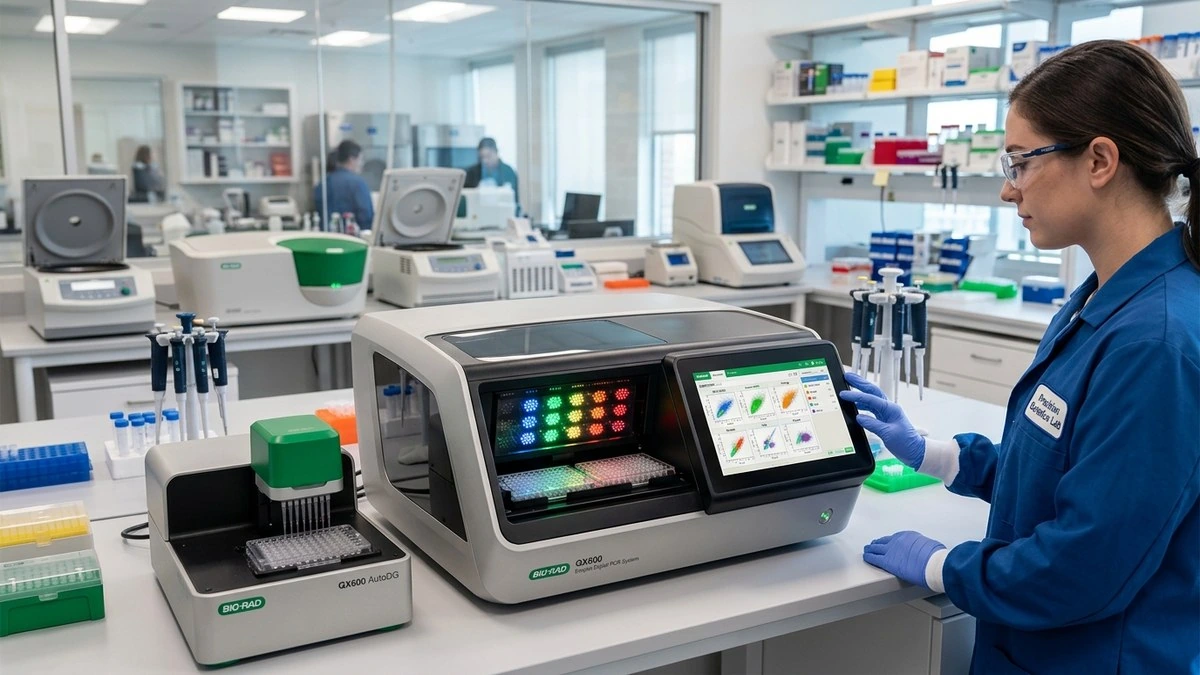
Bio-Rad Laboratories has significantly broadened the analytical capabilities of its flagship QX600™ Droplet Digital™ PCR (ddPCR™) System by introducing certified multi-channel optical calibration standards and advanced target-discrimination software for high-order multiplexing.
Overcoming Two-Channel Optical Constraints #
Standard droplet digital PCR platforms have long been restricted to two-channel optical detection (FAM and HEX/VIC), forcing assay developers to run multiple separate reaction wells, employ complex probe amplitude multiplexing, or accept significant cross-talk when designing multi-mutation liquid biopsy panels. When clinical sample volume is strictly limited (such as neonatal plasma or fine-needle aspirates), running multiple reaction wells risks exhausting irreplaceable material.
The QX600 architecture addresses this bottleneck by incorporating six discrete optical fluorescence detection channels: FAM, HEX, Cy5, Cy5.5, ROX, and ATTO 590.
Multiplex Performance & Validation Benchmarks #
Technical evaluation notes published by Bio-Rad validate key performance parameters:
- Target Multiplexing Density: Enables absolute quantification of up to 12 distinct genetic targets within a single reaction well through dual-fluorophore probe balancing and radial coordinate clustering.
- Massive Partitioning: Partitions reaction mixtures into 20,000 uniform nanoliter droplets per well, preserving absolute digital copy-number quantification without reliance on external calibration curves.
- Analytical Sensitivity (LOD): Confirmed Limit of Blank (LoB) of zero copies, achieving reliable detection of rare mutant alleles down to 0.01% ext{ Variant Allele Frequency (VAF)} against massive wild-type genomic DNA backgrounds.
- Cross-Talk Minimization: Upgraded optical bandpass filters and crosstalk compensation matrices achieve < 0.5% spectral bleed-through across adjacent fluorescence channels.
Six-Color Optical Filter Architecture #
| Optical Channel | Excitation Range (nm) | Emission Range (nm) | Compatible Fluorophores | Primary Application |
|---|---|---|---|---|
| Channel 1 (FAM) | 465–490 | 510–530 | FAM, EvaGreen | Reference wild-type control |
| Channel 2 (HEX) | 525–540 | 555–580 | HEX, VIC, Yakima Yellow | Primary oncogenic mutant |
| Channel 3 (Cy5) | 625–650 | 665–695 | Cy5, Quasar 670 | Secondary resistant mutation |
| Channel 4 (Cy5.5) | 670–690 | 705–735 | Cy5.5, Quasar 705 | Tertiary mutation marker |
| Channel 5 (ROX) | 565–585 | 600–625 | ROX, Texas Red | Viral vector copy reference |
| Channel 6 (ATTO 590) | 585–605 | 620–645 | ATTO 590, CAL Fluor Red 610 | Internal amplification control |
Specialist Perspectives from Assay Development Teams #
"Six-channel optical discrimination marks a turning point for liquid biopsy assay design," stated Dr. Aris Thorne, Head of Molecular Diagnostics Intelligence at BioScienceDesk. "In clinical oncology, minimal residual disease (MRD) monitoring requires tracking multiple primary tumor mutations simultaneously. The QX600 allows labs to build comprehensive multiplex assays on a single 20-microliter blood draw."
Dr. Rachel Sterling, Lead Molecular Assay Scientist at an oncology diagnostics CDMO, shared: "Using the QX600's six-color optical configuration, our team successfully consolidated a six-well EGFR and KRAS mutation assay into a single reaction well. This reduced our hands-on pipetting time by 70%, lowered enzyme consumable costs by $45 per sample, and preserved 80% of our clinical plasma cfDNA for secondary NGS confirmation."
Clinical & Biomanufacturing Applications #
Beyond clinical oncology and liquid biopsy, the expanded multiplexing capability is driving adoption in cell and gene therapy (CGT) manufacturing. Quality control laboratories are utilizing the QX600 for absolute adeno-associated virus (AAV) full-to-empty capsid titering, lentiviral vector copy-number determination (VCN), and detection of residual host cell DNA (rcDNA) down to sub-picogram regulatory limits.