The clinical management of Alzheimer's disease is undergoing its most radical transformation in four decades. With the regulatory approvals of amyloid-targeting monoclonal antibodies such as lecanemab (Leqembi) and donanemab (Kisunla), neurologists now have disease-modifying therapies that can slow cognitive decline—provided patients are diagnosed at the earliest stages of mild cognitive impairment (MCI).
However, diagnosing cerebral amyloid pathology has historically created an insurmountable healthcare bottleneck. The gold standards—amyloid positron emission tomography (PET) neuroimaging and cerebrospinal fluid (CSF) collection via lumbar puncture—are invasive, geographically restricted, and prohibitively expensive.
With the US Food and Drug Administration granting 510(k) clearance to Roche Diagnostics for its Elecsys Phosphorylated Tau 217 (pTau217) plasma immunoassay, clinical neurology and high-volume reference laboratories have secured their first scalable, automated blood test capable of identifying Alzheimer's pathology with accuracy comparable to traditional PET imaging.
A Blood-Based Alternative to Amyloid PET Scans and Lumbar Punctures #
Evaluating cerebral amyloid-beta plaque burden has long represented an operational barrier for community memory clinics:
- Cost and Access Constraints: Amyloid PET scans cost between 3,000 and5,000 per patient, require specialized radiotracers with short half-lives, and are rarely reimbursed outside specialized clinical trial protocols or tertiary academic medical centers.
- Invasiveness of Lumbar Punctures: While CSF testing measuring the Aβ42/Aβ40 ratio and pTau181 provides high diagnostic fidelity, the requirement for a lumbar puncture elicits significant patient apprehension, carries risks of post-dural puncture headache, and demands skilled proceduralists.
Plasma pTau217 has emerged as the definitive blood biomarker because phosphorylated tau at threonine 217 exhibits a dramatic, fold-change increase in peripheral blood early in the disease course, mirroring both cortical amyloid accumulation and subsequent neurofibrillary tangle formation.
High Clinical Concordance with Cerebral Amyloid-Beta Pathology #
FDA clearance was supported by rigorous multicenter clinical validation studies benchmarking the Elecsys pTau217 assay against paired amyloid PET neuroimaging and CSF reference standards:
- Diagnostic Concordance: In prospective cohorts of individuals presenting with objective cognitive impairment (ages 55 to 85), the plasma assay demonstrated > 90% positive and negative percent agreement with Centiloid-defined amyloid PET positivity.
- Exclusionary Power: The assay delivers a 95% negative predictive value (NPV), allowing clinicians to confidently rule out Alzheimer's pathology in patients whose memory complaints stem from other etiologies (such as vascular dementia, depression, metabolic disorders, or frontotemporal lobar degeneration).
- Correlation with Cognitive Trajectories: Longitudinal analysis demonstrated that baseline plasma pTau217 concentrations strongly correlated with future rates of cortical amyloid accumulation and cognitive decline measured by Clinical Dementia Rating Sum of Boxes (CDR-SB) scores over two years.
Assay Sensitivity, Centiloid Correlation and Cutoff Stratification #
To implement the test safely into real-world diagnostic workflows, Roche established a validated two-cutoff stratification model:
| Patient Risk Category | Plasma pTau217 Concentration | Clinical Interpretation | Recommended Action |
|---|---|---|---|
| Negative Zone | Below lower cutoff (< 0.15 ng/L) | High probability of amyloid-negative status | Rule out AD; investigate secondary causes of MCI |
| Intermediate / Gray Zone | Between cutoffs (0.15–0.25 ng/L) | Indeterminate amyloid status (~15% of cohort) | Reflex to CSF confirmation or PET neuroimaging |
| Positive Zone | Above upper cutoff (> 0.25 ng/L) | High probability of cerebral amyloid pathology | Qualifies for anti-amyloid therapy evaluation |
By utilizing this triaged cutoff architecture, memory clinics can definitively classify approximately 85% of presenting patients directly from a simple 5 mL venous blood draw, reserving expensive PET imaging and lumbar punctures exclusively for the ambiguous 15% intermediate cohort.
Integrating Plasma Biomarkers into Routine Neurology Workflows #
From an analytical chemistry standpoint, measuring pTau217 in peripheral plasma requires extreme metrological sensitivity. Concentrations of circulating tau proteins in blood are roughly 100- to 1,000-fold lower than in cerebrospinal fluid, hovering in the sub-picogram per milliliter range.
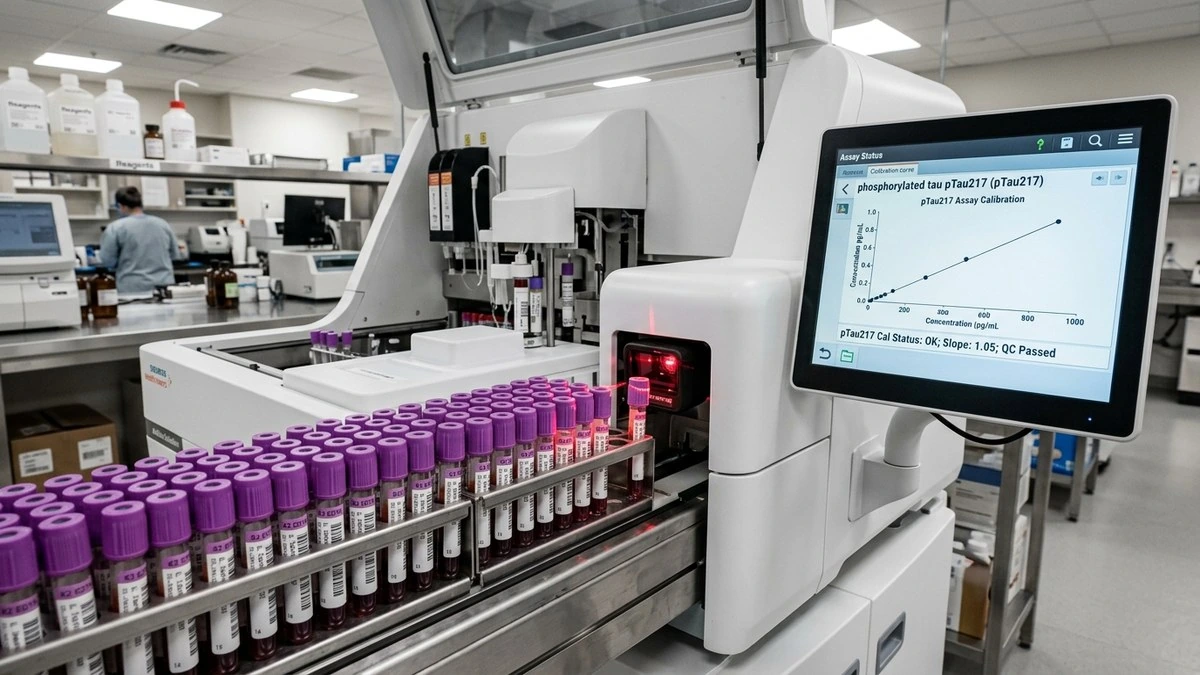
The Elecsys assay utilizes Roche's electrochemiluminescence immunoassay (ECLIA) detection technology, deployed across automated cobas e 411, e 601, and e 801 analyzers:
- Throughput and Automation: Analyzers deliver quantitative results in 18 minutes, handling high-volume outpatient specimen batches without manual pipetting or extraction steps.
- Pre-Analytical Robustness: The assay is validated on standard K2-EDTA plasma collection tubes, showing analytical stability across multiple freeze-thaw cycles and room-temperature storage up to 24 hours.
- Intra-Assay Precision: Across clinical control materials, the platform demonstrates a coefficient of variation (CV) < 5.5%, satisfying strict clinical chemistry quality criteria.
High-Throughput cobas e Implementation and Reimbursement Hurdles #
The broad availability of an FDA-cleared plasma pTau217 assay resolves the diagnostic bottleneck, but full clinical integration depends on reimbursement and guideline adoption. The American Academy of Neurology (AAN) and the Alzheimer's Association have updated diagnostic guidelines to incorporate blood-based biomarkers into formal diagnostic workups.
Major commercial reference laboratories, including Quest Diagnostics and Labcorp, are integrating the Elecsys pTau217 test onto their cobas core platforms under dedicated Current Procedural Terminology (CPT) codes. Crucially, the Centers for Medicare & Medicaid Services (CMS) is reviewing national coverage determinations to ensure that blood biomarker screening is reimbursed as a mandatory prerequisite before initiating costly anti-amyloid antibody infusions.
By replacing invasive spinal taps and multi-thousand-dollar PET scans with a routine clinical blood draw, the Elecsys pTau217 clearance marks the beginning of high-throughput precision diagnostics in neurodegenerative medicine.