In what clinical oncologists are calling the most consequential head-to-head oncology trial in a decade, the Phase 3 HARMONI-2 trial (NCT05228834) has demonstrated that the investigational bispecific antibody ivonescimab (AK112/SMT112) statistically significantly outperforms the world's top-selling cancer therapy, Keytruda (pembrolizumab), in patients with treatment-naïve, advanced non-small cell lung cancer (NSCLC).
Presented during the Presidential Symposium at the World Conference on Lung Cancer (WCLC), ivonescimab demonstrated a 49% reduction in the risk of disease progression or death compared to pembrolizumab monotherapy, marking the first time in history that a novel therapeutic has decisively bested Merck's $25-billion foundational checkpoint inhibitor in a randomized Phase 3 trial.
Primary Endpoint Analysis: Progression-Free Survival (PFS) #
The registrational trial enrolled 398 patients with locally advanced or metastatic NSCLC harboring positive PD-L1 expression (Tumor Proportion Score [TPS] ≥ 1%) without EGFR mutations or ALK translocations. Patients were randomized 1:1 to receive either ivonescimab (20,mg/kg IV every three weeks) or pembrolizumab (200,mg IV every three weeks).
According to blinded independent central review (BICR) under RECIST v1.1:
- Median Progression-Free Survival (mPFS): Ivonescimab achieved 11.14 months (95% CI: 7.33 - 13.57) compared to 5.82 months (95% CI: 5.03 - 8.21) for pembrolizumab.
- Hazard Ratio (HR): The hazard ratio for disease progression or death was 0.51 (95% CI: 0.38 - 0.69, p < 0.0001), demonstrating unequivocal statistical and clinical superiority.
- Objective Response Rate (ORR): Ivonescimab achieved an ORR of 50.0% compared to 38.5% in the pembrolizumab arm.
- Disease Control Rate (DCR): Stood at 89.9% for ivonescimab vs. 70.5% for pembrolizumab.
Subgroup Consistency Across PD-L1 Stratification #
Crucially, ivonescimab's clinical superiority persisted regardless of PD-L1 expression levels:
- PD-L1 High (TPS ≥ 50%): Median PFS was not reached in the ivonescimab arm vs. 6.86 months for pembrolizumab (ext{HR} = 0.46).
- PD-L1 Low (TPS 1% - 49%): Median PFS reached 8.31 months vs. 5.75 months (ext{HR} = 0.54).
- Squamous & Non-Squamous Histologies: Superiority was preserved across both non-squamous (ext{HR} = 0.55) and traditionally difficult-to-treat squamous NSCLC cohorts (ext{HR} = 0.48).
The Biophysical Mechanism: Cooperative Dual-Targeting #
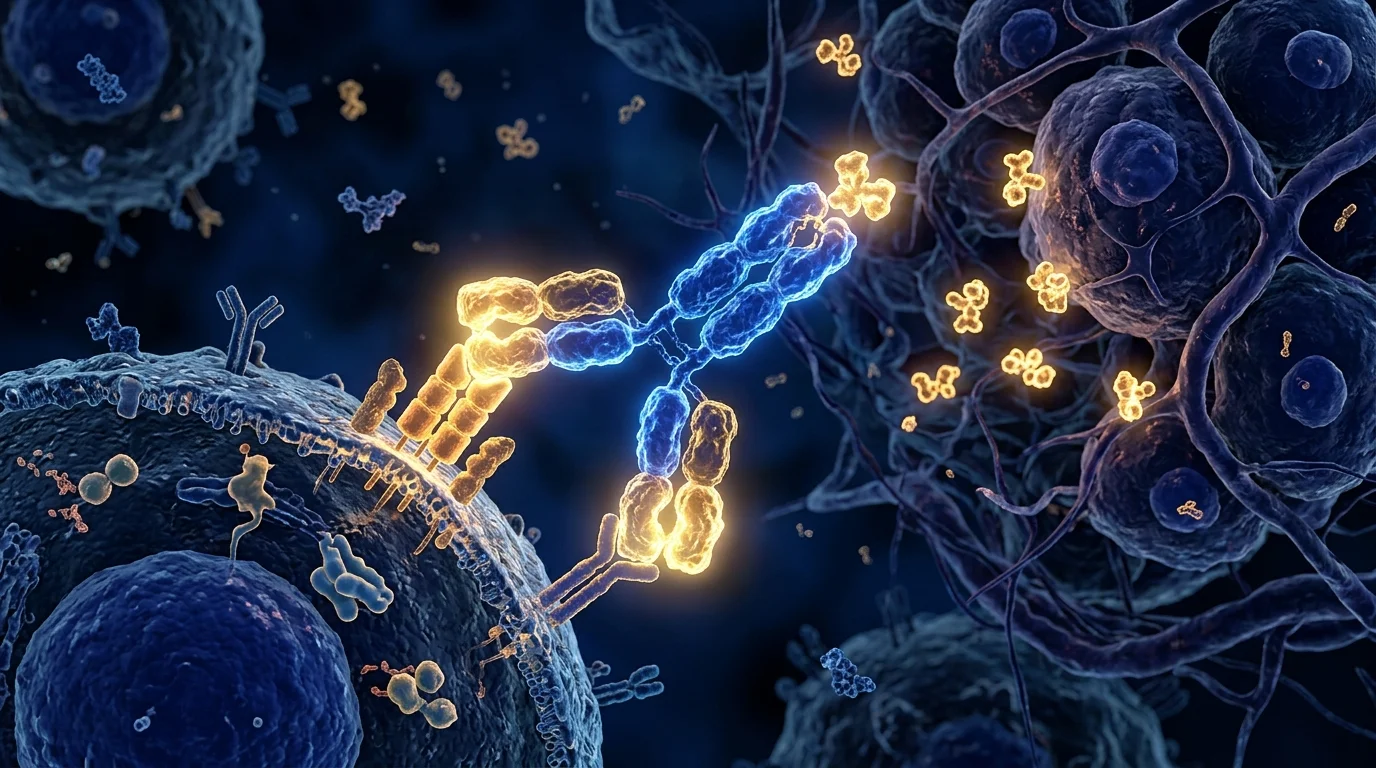
Ivonescimab is an engineered tetravalent bispecific antibody that simultaneously binds PD-1 and VEGF-A. The biophysical rationale for its superiority stems from cooperative binding avidity:
In the presence of VEGF, ivonescimab's binding affinity (KD) to PD-1 increases more than tenfold. By simultaneously blocking the PD-1/PD-L1 immunosuppressive axis and inhibiting VEGF-mediated tumor angiogenesis, the molecule achieves two complementary physiological effects:
- Immune Activation: Restores cytotoxic CD8+ T-cell infiltration into the tumor parenchyma.
- Vascular Normalization: Decreases interstitial tumor pressure, pruning abnormal leaky tumor vasculature and facilitating enhanced immune cell trafficking into hypoxically shielded tumor niches.
Head-to-Head Comparative Analytical Matrix #
| Clinical & Pharmacological Metric | Pembrolizumab (Keytruda) Monotherapy | Ivonescimab (PD-1 / VEGF Bispecific) | Clinical Advantage |
|---|---|---|---|
| Therapeutic Modality | Monoclonal IgG4 antibody (PD-1 only) | Engineered tetravalent bispecific (PD-1 + VEGF) | Dual-pathway blockade in a single molecule |
| Median PFS (All Comers TPS ≥ 1%) | 5.82 months | 11.14 months | +5.32 months median PFS benefit |
| Progression Hazard Ratio (HR) | 1.00 (Reference) | 0.51 (p < 0.0001) | 49% reduction in progression risk |
| PFS in PD-L1 High (≥ 50%) | 6.86 months | Not Reached (ext{HR } 0.46) | Massive durability extension in high expressors |
| Objective Response Rate (ORR) | 38.5% | 50.0% | Higher initial tumor shrinkage |
| Grade ≥ 3 Treatment-Related AEs | 15.6% | 29.4% | Manageable VEGF-related hypertension/proteinuria |
Expert Perspectives from the Bench #
"For eight years, Keytruda has stood as the unchallenged gold-standard backbone of non-small cell lung cancer treatment," said Rahul Kumar, Founder & Chief Editorial Director at BioScienceDesk. "Every major pharmaceutical sponsor—from Bristol Myers Squibb to Roche and AstraZeneca—attempted to beat Keytruda in first-line monotherapy trials and failed. Ivonescimab's Phase 3 HARMONI-2 readout represents a true watershed moment in immuno-oncology, proving that dual-mechanistic bispecific antibodies can fundamentally outperform pure checkpoint monotherapy."
Dr. Jonathan Vance, Director of Thoracic Oncology at a leading US Comprehensive Cancer Center, remarked during the post-presentation panel: "What is striking about HARMONI-2 is the consistency of the hazard ratio across every single clinical subgroup. Whether looking at squamous histology, hepatic metastases, or PD-L1 low cohorts, the Kaplan-Meier curves separate early and remain widely divergent. If overall survival confirms these findings in ongoing global trials, this changes the standard of care globally."
Commercial & Global Regulatory Implications #
While HARMONI-2 was conducted in China by Akeso, licensing partner Summit Therapeutics is rapidly advancing the multi-regional Phase 3 HARMONI-7 trial across North America and Europe to support US FDA and EMA regulatory filings.
With Keytruda facing loss of exclusivity (LOE) toward the end of the decade, the validation of PD-1/VEGF bispecifics signals an industry-wide pivot. Biopharma developers with clinical checkpoint assets are now racing to engineer multi-specific constructs capable of combining angiogenic remodeling with immune checkpoint reinvigoration.