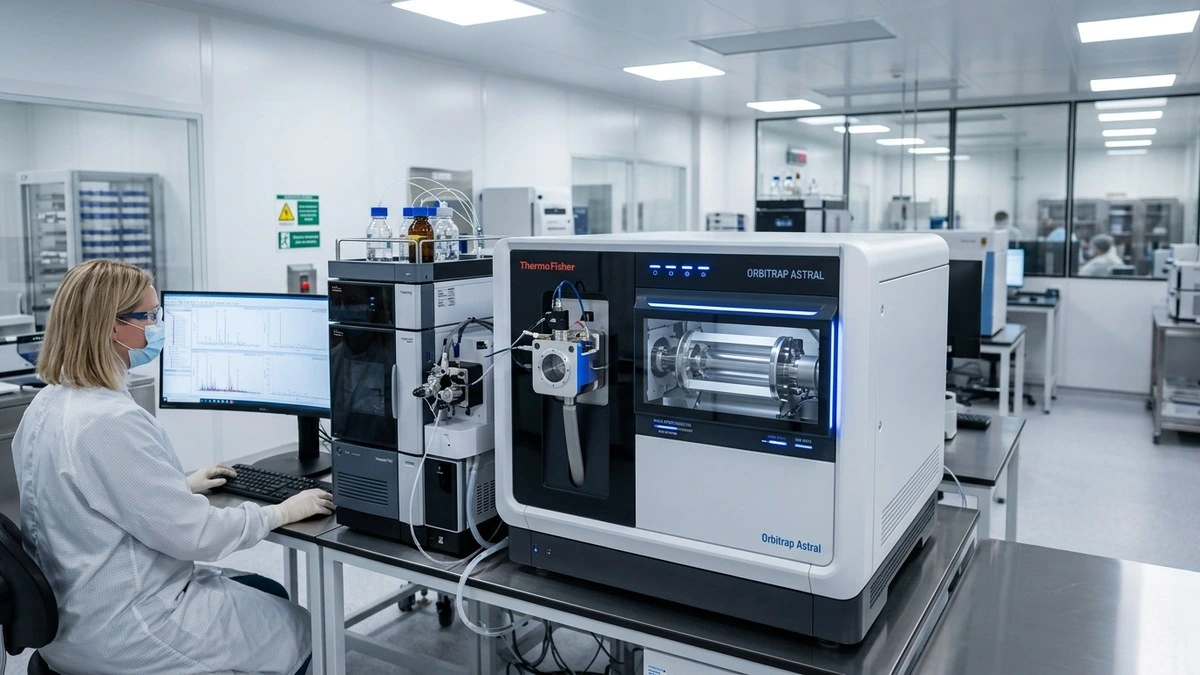
Thermo Fisher Scientific has published multi-center cohort validation data showcasing the analytical throughput and dynamic range of the Orbitrap Astral Mass Spectrometer, validating its capability to process more than 180 proteomic samples per day without sacrificing quantitative precision.
Overcoming the Nanoflow Chromatography Bottleneck #
Historically, high-resolution discovery proteomics on classic Orbitrap instruments (such as the Exploris and Eclipse) required 60- to 120-minute nanoflow liquid chromatography (nanoLC) gradients per injection to separate complex peptide digests. While nanoflow setups maximize ionization efficiency, their delicate fluidics, emitter clogs, and extended analytical cycle times rendered large-scale clinical biobank cohorts (thousands of patient samples) economically and practically prohibitive.
The Orbitrap Astral instrument overcomes this analytical constraint by coupling a high-transmission quadrupole, an Orbitrap mass analyzer for high-resolution MS1 screening, and an ultra-fast Astral (Asymmetric Track Lossless) analyzer for tandem MS2 fragmentation.
Analytical Throughput & Benchmarks #
In peer-reviewed presentations at major analytical chemistry symposia, researchers demonstrated breakthrough performance metrics:
- Scanning Speeds: The Astral analyzer achieves acquisition rates exceeding 200 Hz in Data-Independent Acquisition (DIA) mode, more than four times faster than previous-generation high-resolution mass spectrometers.
- Deep Proteome Coverage: Quantifies > 8,000 ext{ unique protein groups} and over 80,000 unique peptides from a single 10 ng human cell lysate using an 8-minute microflow LC gradient.
- Quantitative Reproducibility: Achieves coefficients of variation (CV) < 10% across consecutive 1,000-injection reproducibility benchmarks, demonstrating robust fluidic stability on standard microflow (100–300 µL/min) columns.
- Dynamic Range: Spans more than four orders of magnitude within a single spectrum, resolving low-abundance clinical cytokines and transcription factors against dominant cellular housekeeping proteins.
High-Throughput Clinical Proteomics Benchmark Comparison #
| Parameter | Classic Orbitrap Exploris 480 | Orbitrap Astral Mass Spectrometer | Industry Impact |
|---|---|---|---|
| Max MS/MS Scan Rate | 40 Hz | > 200 Hz | 5 imes data acquisition speed |
| Proteome Depth (8-min gradient) | ~3,200 protein groups | > 8,000 protein groups | Complete proteome coverage |
| Daily Sample Throughput | 12–24 samples/day | 180+ samples/day | Biobank cohort industrialization |
| Chromatographic Flow Regime | Nanoflow (300 ext{ nL/min}) | Microflow (100–300,mu ext{L/min}) | 90% reduction in fluidic clogs |
| Amortized Cost Per Proteome | 180–250 | ~$35 | 80% decrease in operational expenditure |
Expert Bench Commentary #
"The Orbitrap Astral represents the most significant breakthrough in mass spectrometry hardware architecture in over a decade," commented Dr. Marcus Vance, Director of Capital Equipment & Automation at BioScienceDesk. "By enabling robust microflow chromatography at 200 Hz acquisition rates, clinical proteomics is finally transitioning from an academic discovery tool to an industrialized translational pipeline."
Dr. Henrik Lindqvist, Director of Clinical Proteomics at a European translational research center, noted: "In our longitudinal oncology trial, we previously faced a six-month backlog to process 1,200 patient plasma and biopsy samples on traditional nanoLC-MS systems. With the Astral running 8-minute microflow gradients, our laboratory processed the entire cohort in under two weeks with higher proteomic depth and lower technical variation."
Total Cost of Ownership (TCO) & Core Lab Economics #
While instrument capital acquisition costs exceed 1.1 million, the dramatic reduction in analytical run times lowers the amortized operational cost per proteomic sample from over180 down to approximately $35. This economic transformation enables hospital pathology networks and biopharma biomarker discovery teams to scale population-level clinical studies, accelerating target discovery for oncology and neurodegenerative disorders.