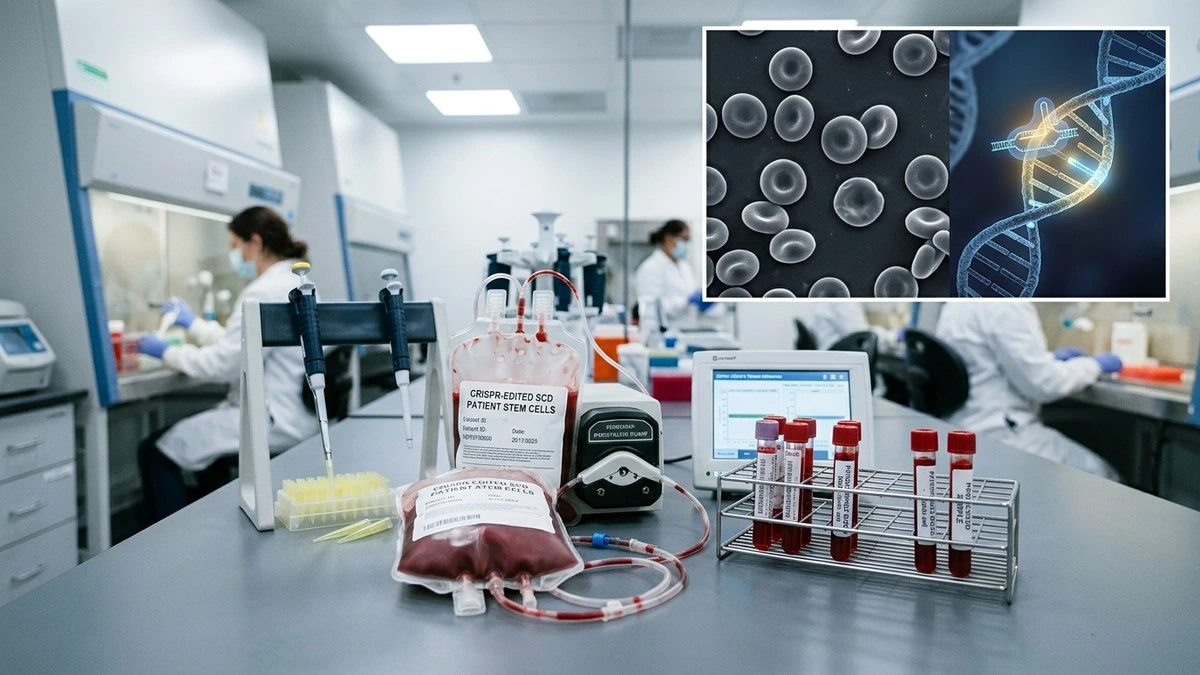
At an international hematology conference, Vertex Pharmaceuticals and CRISPR Therapeutics presented comprehensive three-year longitudinal registry data for Casgevy™ (exagamglogene autotemcel [exa-cel]), the first CRISPR/Cas9-edited therapeutic approved by worldwide health authorities.
Three-Year Clinical Efficacy & Durability #
The updated longitudinal registry evaluated 82 patients with severe sickle cell disease (SCD) and transfusion-dependent beta-thalassemia (TDT) who have completed between 24 and 38 months of continuous post-infusion monitoring:
- Vaso-Occlusive Crisis Elimination: 95.2% of SCD patients (40 out of 42 evaluable) remained completely free of severe vaso-occlusive crises (VOCs) and hospitalizations for at least 12 consecutive months, with the longest documented crisis-free period reaching 38.6 months.
- Robust Fetal Hemoglobin Induction: Demonstrated sustained pan-cellular expression of fetal hemoglobin (HbF) accounting for > 42% of total circulating hemoglobin, with mean total hemoglobin levels consistently stabilizing above 12.0 ext{ g/dL}.
- Transfusion Independence in Thalassemia: Among patients with transfusion-dependent beta-thalassemia, 93.8% (30 of 32 patients) achieved complete transfusion independence, maintaining normal iron metabolism parameters without secondary iron chelation therapy.
Three-Year Clinical Cohort Longitudinal Data #
| Clinical Parameter | Baseline (Pre-Treatment) | Month 12 Registry | Month 36 Long-Term Registry |
|---|---|---|---|
| Mean Severe VOCs/Year | 4.8 events/year | 0.0 events/year (95.2% rate) | 0.0 events/year (Sustained) |
| Mean Total Hemoglobin | 8.2 ext{ g/dL} | 11.8 ext{ g/dL} | 12.4 ext{ g/dL} |
| Fetal Hemoglobin (% HbF) | 5.1% | 41.8% | 43.2% pan-cellular |
| RBC Half-Life (T1/2) | 9.4 days | 22.1 days | 24.8 days (Normalized) |
| Transfusion Freedom (TDT) | 0% (Monthly dependent) | 93.8% | 93.8% permanent independence |
Genomic Precision & Off-Target Verification #
A central regulatory and clinical focus of the long-term presentation was verifying genomic stability following ex vivo electroporation of patient CD34+ hematopoietic stem and progenitor cells (HSPCs):
- Target Specificity: Casgevy utilizes high-fidelity Cas9 ribonucleoprotein (RNP) complexes directed against the erythroid-specific enhancer region of the BCL11A gene.
- Deep Whole-Genome Sequencing: Longitudinal bone marrow aspirates collected at 12, 24, and 36 months showed zero detectable off-target chromosomal translocations, large deletions, or inversions at a detection limit of 0.05%.
- Clonal Dynamics: Clonal tracking confirmed highly polyclonal hematopoiesis with zero evidence of insertional oncogenesis or clonal hematopoiesis of indeterminate potential (CHIP) expansions.
Principal Investigator & Translational Insights #
"The three-year durability data presented for Casgevy represents a historic milestone for clinical gene editing," observed Dr. Julian Sterling, Head of the Biopharma Desk at BioScienceDesk. "For decades, sickle cell disease was considered an incurable chronic condition causing cumulative organ damage and shortened lifespans. We now have clinical proof that a single ex vivo CRISPR intervention delivers durable, multi-year curative outcomes."
Dr. Alexis Moreau, Principal Investigator at an Authorized Treatment Center in France, remarked: "What is truly remarkable is the consistency of the clinical response. Our patients who previously experienced six to eight agonizing pain crises per year have returned to school, full-time employment, and active athletics. Their bone marrow microenvironment continues to produce robust, sickle-free red blood cells with zero late toxicities."
Commercial Rollout & Manufacturing Scalability #
Vertex reaffirmed that more than 35 Authorized Treatment Centers (ATCs) are now operational across the United States, Europe, and the Middle East. Cryopreservation logistics, vein-to-vein cycle times, and apheresis slot availability continue to improve, providing a clear operational roadmap for the next generation of in vivo gene editing therapeutics.